

You knew it was coming.
The date was on every calendar. The polls had been picked apart for weeks. Everyone had a view on what the 2026 US midterms would do to the markets.
And yet, when the results finally landed in the early hours of Wednesday morning, the market still caught plenty of traders off guard.
Democrats won control of both the House and the Senate (Forbes). US stock futures slid, the dollar softened, and gold pushed back above $4,000 an ounce (CNBC).
But we didn’t just want to know what the market did. We wanted to know what traders did.
So we went through the activity on City Traders Imperium accounts, from election day through to the European open. What we found says a lot about patience, positioning, and where traders put their attention when it really counts.
Trading the 2026 midterm elections
CTI traders held back on election day, opening about half as many positions as usual. Once results came in, activity doubled, peaking at 3 – 4x the normal hourly rate between 04:00 and 06:00 UTC. Gold was the most traded market and turned bullish; US indices saw up to 4x normal activity, and Bitcoin and the DAX were largely ignored. News trading isn’t restricted at CTI, so traders were free to trade the results as they landed.
All trader figures in this post are CTI’s own aggregated platform data, compared with a normal Tuesday or a normal night. They describe what traders did, not what they should do, and don’t indicate future performance.
Election Day: Logged In, Hands Off
On Tuesday, our traders showed up.
They just didn’t do much.
The number of active traders was only about 10% below a normal Tuesday. But each one opened roughly half as many positions as usual.
That’s not hesitation. That’s patience.
Before a binary event, price doesn’t move with intent. It drifts, it chops, it fakes. Any position opened at lunchtime has to survive whatever lands at midnight – and you have no idea what that will be.
Most of our traders seemed to understand that. They watched. They waited. They let the market come to them.
If you’re working through a challenge with a daily drawdown limit, this is the habit worth copying. Sitting out the hours before a known event costs you nothing, and it keeps your drawdown intact for when the real move arrives.
Results Night: Then Everything Moved
Once the results started landing, the mood flipped.
Across the night, traders opened about twice as many positions as normal.
The real rush came between 04:00 and 06:00 UTC on Wednesday. That’s 11 pm to 1 am in New York, right as the big calls were coming through, with the Senate projected shortly after 11:30 pm Eastern (CBS News).
In that two-hour window, positions were opening at three to four times the normal hourly rate.
And then… it was over.
By the time Europe sat down to breakfast, activity had cooled to about 30% below the usual pace. The market had already priced in most of the news.
If you woke up on Wednesday planning to trade the election, you were already late.
We made this point in our blog on Trading During Global Tension: prediction gets you in too early, reaction gets you in too late. Election night was a live demonstration of both.
Gold: The Main Event
If election night had a headliner, it was gold.
Positions opened on gold were up 77% on a normal night.
But the more interesting story is how traders’ views shifted.
Before the results, gold traders were split almost evenly. Half long. Half short. No real conviction either way.
Once the results came in, the balance tipped:
- The number of traders going long was up 24% on a normal night.
- Longs ended up outnumbering shorts by about 13%.
That lean lined up with price. Spot gold climbed around 2.6% to roughly $4,032 an ounce by early Wednesday in New York (CNBC), with a softer dollar and falling Treasury yields doing the heavy lifting.
Still, look at the size of that edge.
13% is a lean. Not a stampede.
Plenty of traders were happy to fade the move, and that’s healthy. When everyone agrees on a trade, the market usually finds a way to make them pay for it.
US Indices: Same Night, Three Different Stories
This is where it got interesting.
Before the results, our traders leaned long across the US indices. Afterwards, that lean turned mixed or short. But each index told its own story.
- Dow Jones (US30): Positions opened hit 4x normal, and the number of traders more than tripled. Shorts outnumbered longs by about a third – which is unusual for this market.
- S&P 500 (US500): Also 4x normal. But here, longs outnumbered shorts 3 to 1.
- Nasdaq (USTEC): Positions opened up about 50%, with traders split right down the middle.
So on the same night, the same community was shorting the Dow and buying the S&P.
How does that add up?
Our read: traders used the Dow to express the “this is bad for stocks tonight” view as futures slid. And they used the S&P to buy the dip.
There’s a well-known stat behind that second instinct. Since 1950, the S&P 500 has been higher 12 months after every one of the 19 midterm elections (Mitrade). Some traders clearly had that in the back of their minds.
And the Nasdaq coin flip? Reuters reported that Democratic gains were stoking fears of tougher AI regulation (MarketScreener). That’s a real headwind for big tech, but nobody knows how big yet.
A 50/50 split is exactly what uncertainty looks like in positioning.
Forex: The Dollar Pairs Went Their Separate Ways
The dollar softened as the results came in, with the dollar index down about 0.3% by Wednesday morning (CNBC).
You might expect traders to pile into one clean “sell the dollar” trade.
They didn’t.
- AUDUSD: Positions opened were 2.7x normal, and about 50% more traders went short than long. On a night the dollar was on the back foot, that’s a contrarian call – and a bold one.
- USDJPY: More than double the usual positions, with traders split evenly. Plenty of action. No consensus.
- GBPUSD: Long traders outnumbered shorts by more than 2 to 1, a stronger long lean than usual. For many, this was the cleanest way to sell the dollar.
- EURUSD: Barely moved. Long and short traders were level, and positions opened were about 25% below normal.
That EURUSD number might be the most telling stat of the night.
The most traded currency pair in the world. The biggest US political night of the year.
And our traders mostly left it alone.
Why? Because when there are cleaner ways to trade a story, you use them. Gold, the indices, and cable gave traders a sharper reaction. EURUSD didn’t.
The scoreboard: what traders piled into, and what they ignored
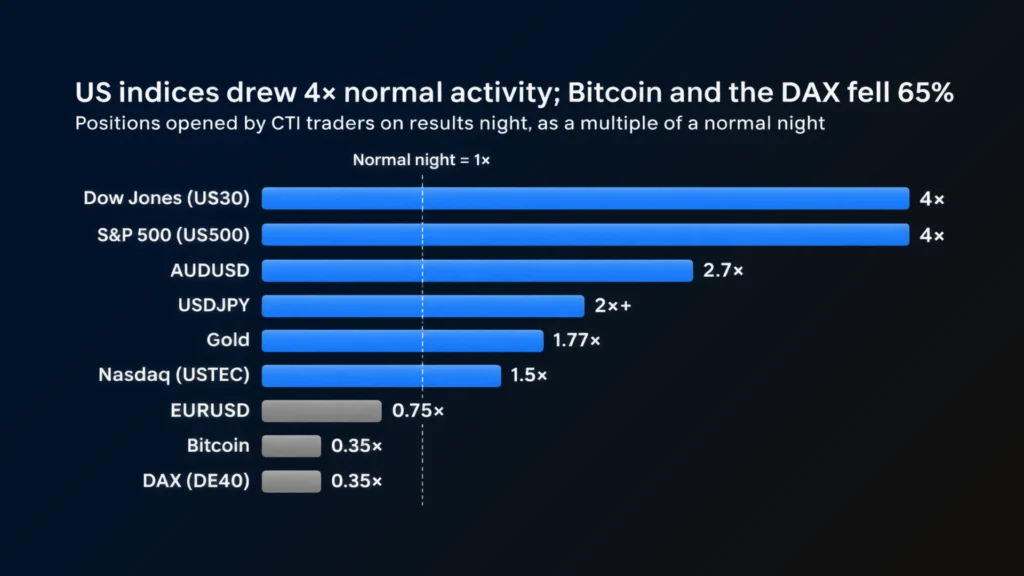
At the bottom of the board sit Bitcoin and the DAX (DE40), with positions opened down about 65% on a normal night.
For Bitcoin, that’s a big drop. It’s usually the market people reach for when things get dramatic.
Not this time.
The DAX is easier to explain. Germany’s main index was simply too far from the story. With US indices offering a direct line to the result, nobody needed a European stand-in – least of all at 5 am Frankfurt time.
Final Thoughts: What Election Night Teaches Every Trader
Strip away the politics, and election night was a test.
Not of who could predict the result. Of who could wait for it.
Here’s what the data says:
- Waiting is a position. Our traders halved their activity before the results – and kept their drawdowns intact for the moment that mattered.
- Trade the cleanest line to the story. Gold, the US indices and GBPUSD reacted directly to the result. EURUSD, Bitcoin and the DAX didn’t, so traders looked elsewhere.
- The window is short. Most of the action happened in two hours. If you can’t be at your screen for that window, think hard before leaving positions open through it.
- Disagreement is normal. Even on gold, the clearest move of the night, longs led shorts by only 13%. You don’t need the crowd on your side. You do need a plan for being wrong.
- Know your rules before the event, not during it. News trading isn’t restricted at CTI, so nights like this are yours to trade. But freedom isn’t a plan. News brings gaps, slippage, and fast swings, so know your drawdown limits, size down, and decide your exits before the first result lands.
There will be another night like this. A Fed decision. A jobs report. A headline at 3 am.
The traders who come through it won’t be the ones who guessed right.
They’ll be the ones who were patient before the move, and decisive when it finally came.
Ready for the Next One?
If you want to build that kind of patience with real capital on the line, City Traders Imperium has been funding traders since 2018. Every challenge comes with CTI Academy included, up to 100% profit share, and a path to scale to $4M.
Not sure yet? Start with a free trial and see how we operate before you spend a cent.
Trading the Midterms: Your Questions Answered
How did markets react to the 2026 midterm elections? As Democrats won the House and Senate, US stock futures slid, Treasury yields fell, the dollar softened, and gold climbed back above $4,000 an ounce.
Why did gold rise after the midterms? A weaker dollar and lower Treasury yields made gold more attractive, and political uncertainty added some safe-haven demand.
When was the busiest time to trade the midterm results? Among CTI traders, activity peaked between 04:00 and 06:00 UTC on Wednesday, when positions opened at three to four times the normal hourly rate.
Do stocks usually rise after midterm elections? Historically, yes. The S&P 500 has been higher 12 months after every midterm since 1950, though past performance doesn’t guarantee future results.
Is it a good idea to trade during elections? It can be, if you plan for it. Volatility brings opportunity and risk in equal measure, so cut position size, know your drawdown limits, and set exits in advance.
Can you trade news events like elections with a prop firm? It depends on the firm, as some prop firms restrict trading around high-impact news. At City Traders Imperium (CTI), news trading is not restricted, so traders can trade events like election results, NFP, CPI, and FOMC on both challenge and funded accounts.
Trading forex, indices, and commodities on margin carries a high level of risk and may not be suitable for everyone. This article is for information only and is not investment advice. CTI trader data reflects aggregate activity on CTI accounts and does not indicate future performance.
Sources
- CBS News: 2026 midterm live results
- Forbes: Democrats sweep House and Senate
- CNBC: Gold, silver jump, dollar dips as Democrats take control of Congress
- Reuters via Yahoo Finance: Gold rises as dollar weakens
- MarketScreener: Gold jumps over 2% after Democratic midterm wins
- Mitrade: Gold edges higher as midterm results hit the dollar


