


Introduction
Drawdowns can make or break your journey with City Traders Imperium
If you’re currently funded by a prop firm — or planning to join one — there’s one concept you absolutely need to master: drawdowns.
In short, drawdowns refer to the decline in your account from a peak to a low. They are a must and essential for effective risk management.
Understanding the types of drawdowns that prop firms use can have a significant positive impact on your funded account. After all, managing drawdowns is a key factor in preventing the loss of your funded account.
This guide cuts through the confusion. You’ll learn the key types of drawdowns, how they’re calculated, and how City Traders Imperium keeps things fair with trader-friendly rules.
Key Findings
- Drawdowns measure the decline from peak to low in a trading account — a crucial concept for risk management.
- Prop firms use different types: balance-based, equity-based, static, trailing, and daily drawdown.
- Equity-based drawdown can terminate accounts prematurely, taking into consideration any floating profit, in the drawdown calculation.
- CTI uses trader-friendly rules with no equity-based drawdowns, allowing you to focus on long-term growth.
- You can calculate drawdowns with our free drawdown calculator.
- Understanding your prop firm’s stop-out rules is key to avoiding violations and account termination.
- Practice risk management with a free trial prop firm account before going live.
What Is a Drawdown in Trading?
Drawdowns represent how much your account drops during a losing streak and how close you are to violating the rules of a funded account challenge. Let’s break it down step by step.
Definition
At its core, a drawdown is the amount your trading account falls from a high point to a low point. It’s a simple but powerful metric that quantifies your potential risk and loss.
Think of it as a way to measure how much money you’ve “given back” during a losing streak. It’s a key part of risk management and shows how much of your account is at risk before losing a funded account.
However, different types of drawdowns are calculated differently, depending on the kind of drawdown, which we will explain in more detail in the next section.
Why Drawdown Matters to Prop Traders
Drawdowns are more than just numbers. They directly affect your trading performance, psychology, and funding status.
Here’s why drawdowns are important:
- They act as a benchmark for the prop firm’s risk tolerance.
- They help you evaluate the effectiveness of your trading strategy during losing streaks.
- They ensure that you adhere to proper risk management principles to achieve long-term success.
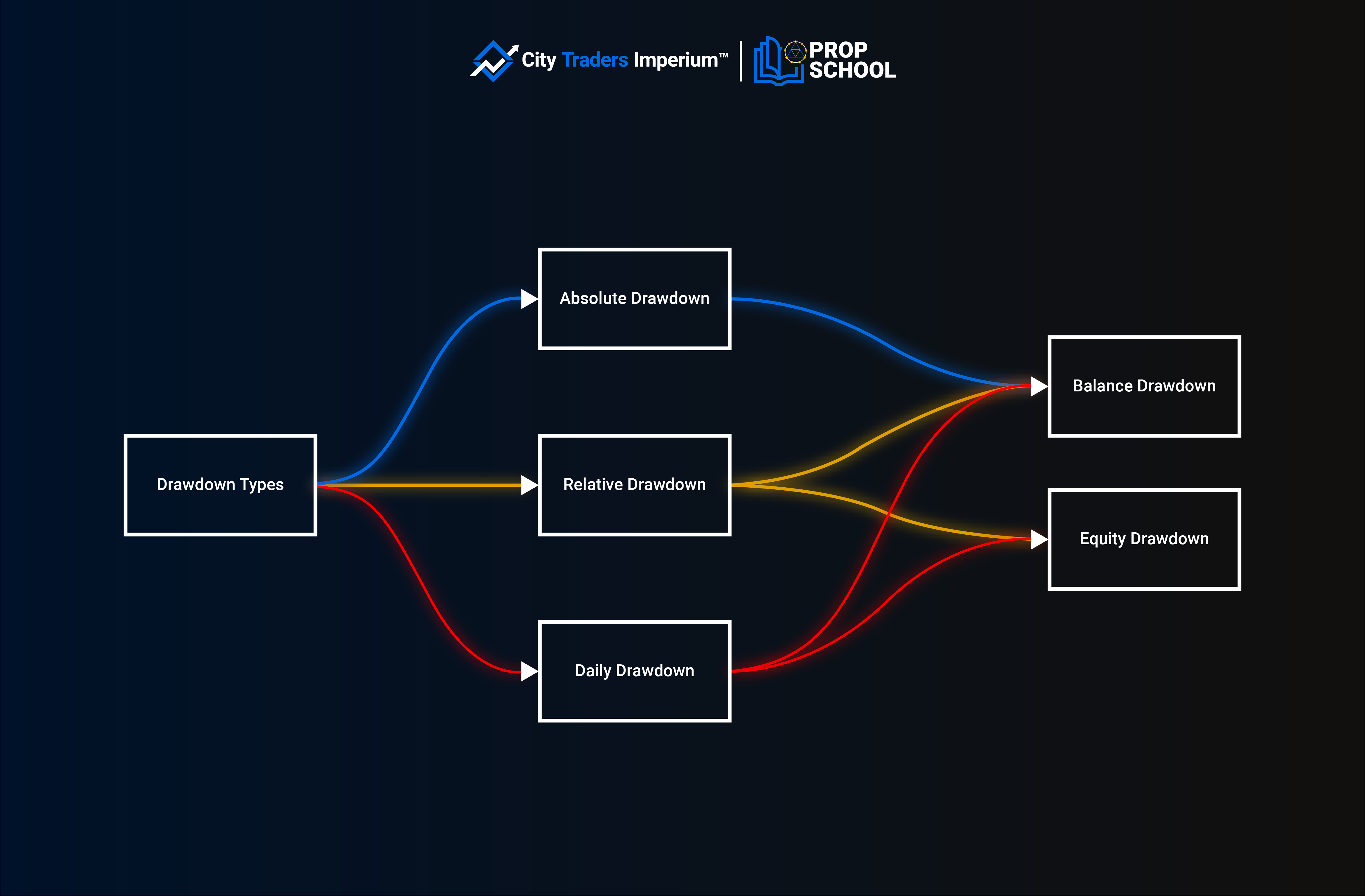
Types of Drawdowns In Prop Trading
Prop firms usually apply a combination of drawdown types. That’s why it’s crucial to understand both how they start measuring and where they stop you.
For example, at CTI, we use a Balance-Based Daily drawdown in our 2-Step Challenge, whereas other firms might apply a more aggressive Equity-based approach.
Let’s take a closer look at the key drawdown types:
Key Definitions in Drawdowns Calculations
To understand how drawdowns work, it’s important to understand two key elements when calculating a drawdown:
The Drawdown High Point
This is the high point from which the drawdown is calculated. For example, the high point could be the start of day balance, or initial balance, etc…
This High Point can change depending on the drawdown type. So, in the next sections, this is the part that makes drawdown calculations different.
Stop Out Level
A Stop-Out Level is the lowest balance, or equity, at which your funded account would be in violation of the drawdown rule if reached.
The Stop Out Level depends on how the Drawdown High Point is calculated.
This is the point of no return. If your account reaches this level, it’s in breach and will be terminated. So, you must know your stop-out level in relation to your drawdown type.
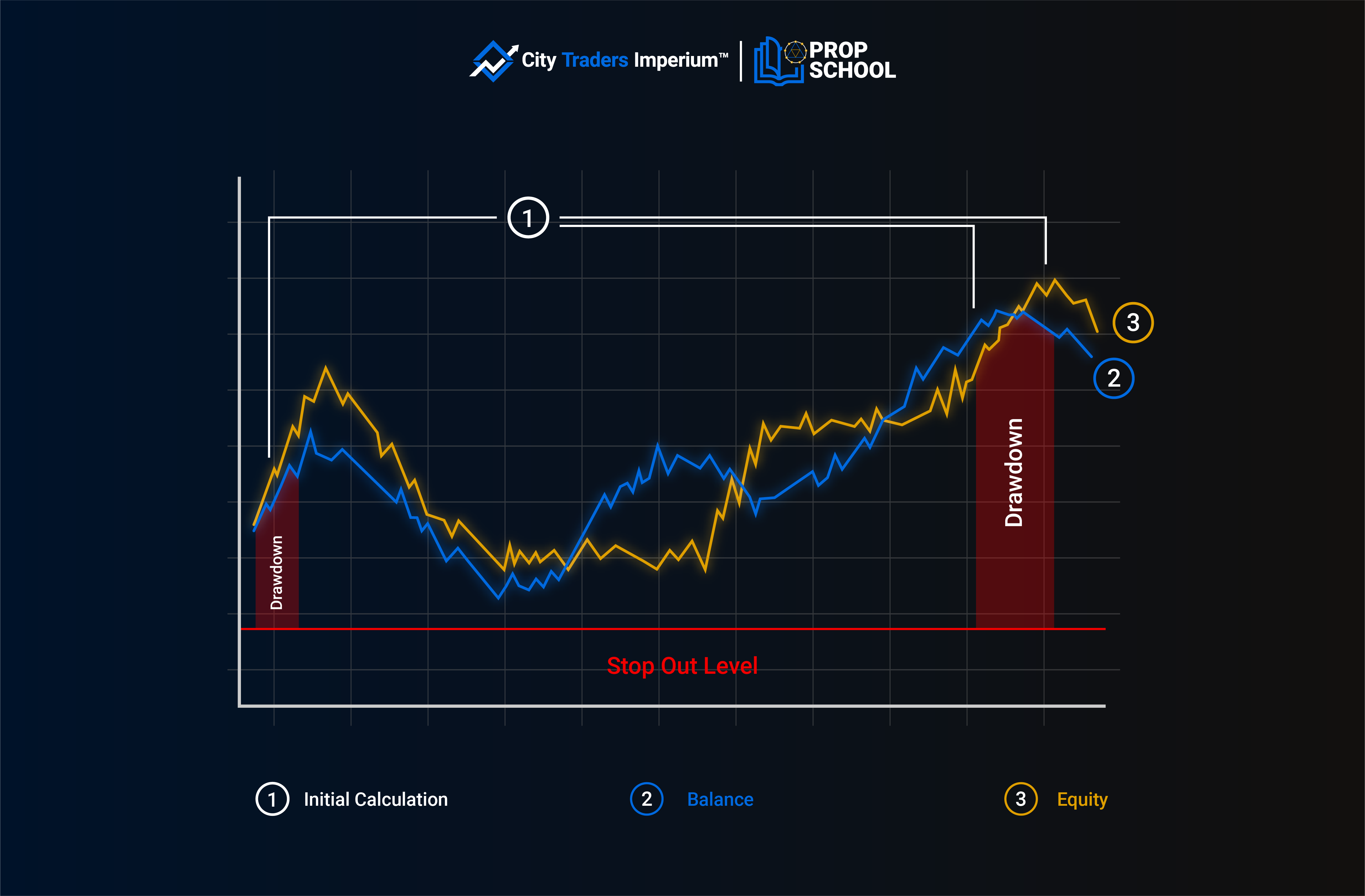
Balance-Based Drawdown
The balance represents the total funds in a funded account. It includes the initial balance and any profits or losses from closed trades. It is the net amount available for trading purposes.
A Balance-Based drawdown is calculated using your account’s closed trade results only. It ignores any floating (unrealised) profits or losses. This gives you more flexibility, especially if your trades experience temporary drawdowns before moving into profit.
Balance Drawdown Formula
Balance-Based Drawdown = Initial Balance + Net P&L resulting from closed trades.
📌 Example of a Balance-Based Drawdown:
Let’s say you start your day with $100,000, and your max daily drawdown for that day is $5,000 ( 5% of $100,000).
You close some trades, and your balance reaches $105,000.
Later, you close losing trades and your balance drops to $101,000.
Your Stop Out Level for that day remains $100,000 – $5,000 = $95,000.
If your equity (including floating losses) drops below $95,000, your account will be closed — even if you haven’t closed those losing trades.
Because it’s balance-based, this method protects you from being penalised for price movement against your open trade. That’s why CTI is a prop firm with balance-based drawdown across all funding programs — it allows traders to hold trades longer and manage positions without fear of floating losses triggering a breach
⚠️ Common Misunderstanding
Some traders think that because it’s “balance-based,” they can keep open trades running forever and only get stopped out if closed losses push the balance below the limit.
❌ That’s not correct.
✅ Floating losses always count — they affect your equity, and if your equity drops below the max loss allowed, your account will be stopped out even with trades still open.
This is a risk control rule that all prop firms use to protect the account from blowing up on the downside.
Equity-Based Drawdown
This one is more dynamic. Prop Firms using Equity-Based drawdown look at whichever is higher between:
- The Balance (like in the Balance-Based Drawdown), OR
- The balance and any floating (unrealised) profit of open positions.
This means that if the Equity (Balance + floating profit) is higher than the Balance, then the high of the Equity is the Drawdown High Point.
Otherwise, if the Balance is higher than the Equity, then the Balance is the Drawdown High Point.
This means, if a prop firm uses equity-based drawdown as the highest account value, it makes it harder for traders to get funded because the drawdown is based on the highest value of their floating profits.
Equity-Based Drawdown Formula
Equity-Based Drawdown = The Highest of Equity or Balance.
📌 Example of an Equity-Based Drawdown:
Imagine you start the day with a $100,000 account. Your maximum daily drawdown is 5%, which means you can’t lose more than $5,000 in a day.
During the day, your open trades go into profit, and your equity (balance plus floating profit) rises to $105,000 — even though your actual balance is still $100,000 because you haven’t closed the trades yet.
With an equity-based drawdown, your stop-out level adjusts to your peak equity for the day. So instead of being allowed to drop down to $95,000 (like with a balance-based drawdown), your stop-out is now:
$105,000 – $5,000 = $100,000
This means that if your floating profit drops back to zero — bringing your equity down to $100,000 — you’ve hit your maximum daily drawdown limit for the day, even though your balance didn’t change.
If you’re with a prop firm that uses equity drawdown, you’d violate their rule even if your account’s balance hasn’t lost 5%, yet. This can catch many traders off guard.
Traders with higher profit fluctuations typically suffer the most from equity-based drawdowns. This means that the stop-out level rises each time the account’s equity reaches a new high, even if the account balance remains unchanged.
So, if you see a prop firm using an equity-based drawdown, this is your red flag 🚩 to avoid it.
Absolute Drawdown (Aka Static or Fixed Drawdown)
Absolute drawdown (also referred to as static or fixed) measures how much your account has dropped below your starting balance. Regardless of how high your account went. It sets a hard stop-loss for your overall capital risk.
Formula: Absolute Drawdown = Initial Balance – Lowest Balance
📌 Example of a Static Drawdown:
Let’s say you start with a $100,000 account, and your static drawdown limit is 10%.
This means you can’t lose more than $10,000 from your starting balance, no matter how high your account grows.
Your account balance grows to $105,000.
Later, it drops to $90,000.
The loss (including your floating losses) allowed from your original starting balance is $100,000 – $90,000 = $10,000.
Since that matches your 10% drawdown limit, you would hit your stop-out level at $90,000, and your funded account would be breached.
Unlike relative drawdowns, this stop-out level never changes, no matter how much profit you generate. This fixed structure offers clarity and is the standard at most prop firms (CTI included), making risk management simple and predictable.

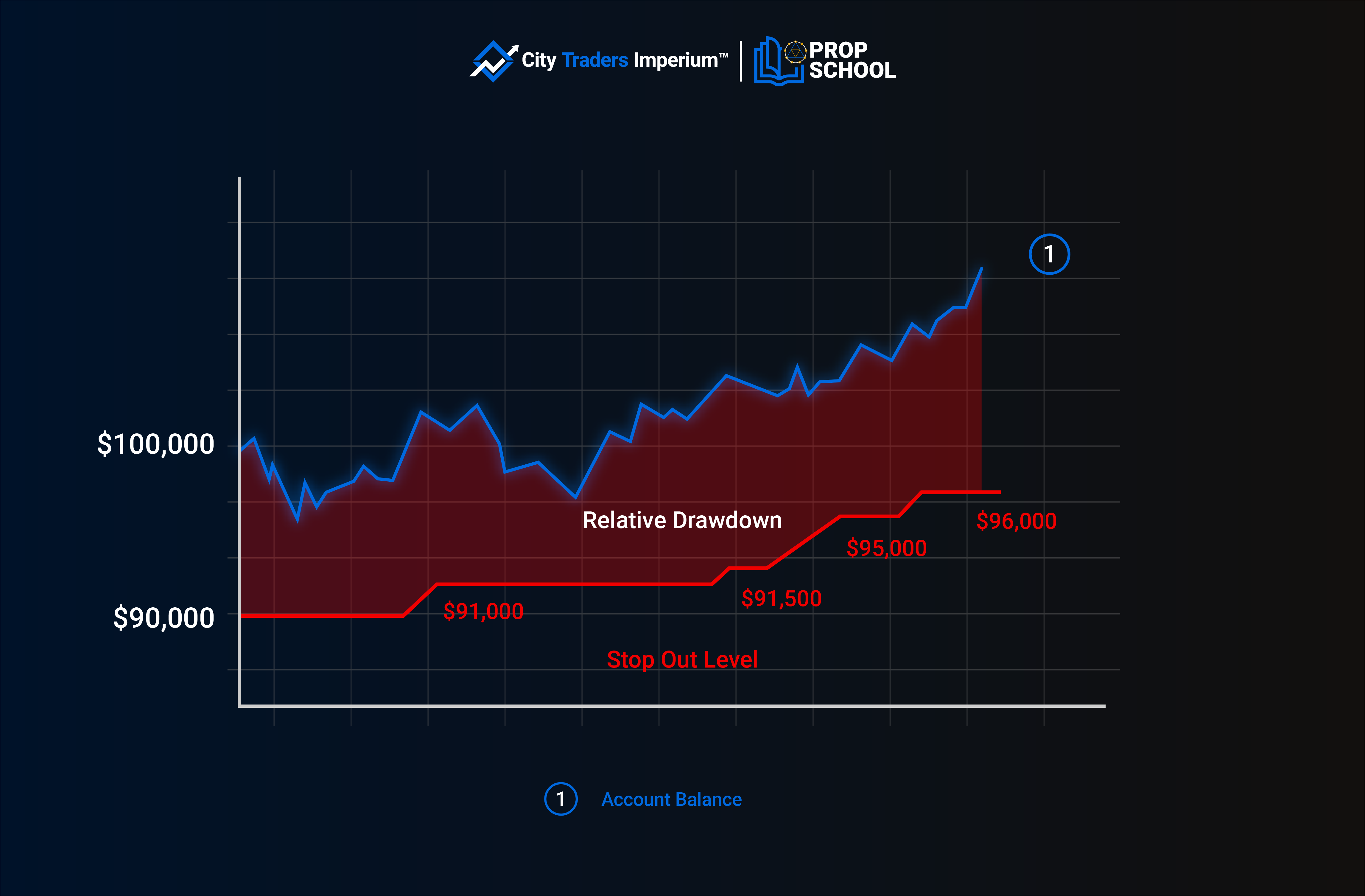
Trailing Drawdown (Aka Relative or Smart Drawdown)
Relative drawdown measures the largest drop in a trading account’s balance from its peak. It is updated as new peaks are reached. It gives traders a real-time view of the account’s drawdown and measures it against the account’s highest value at any point.
Formula
Trailing Drawdown = Highest Account Balance – (Initial Account Balance x 10%)
📌 Example of a Trailing Drawdown:
You start with a $100,000 account, and your trailing drawdown limit is 10% of your starting balance.
Your balance grows to $106,000.
With a trailing drawdown, your stop-out level moves up as your account balance increases:
$106,000 − $10,000 = $96,000
So now, if your balance falls below $96,000, you violate the trailing drawdown rule and your account would be breached.
Unlike a static drawdown, which stays fixed at your starting balance, a trailing drawdown “locks in” profit milestones as your balance grows.
Max Daily Drawdown or Daily Loss
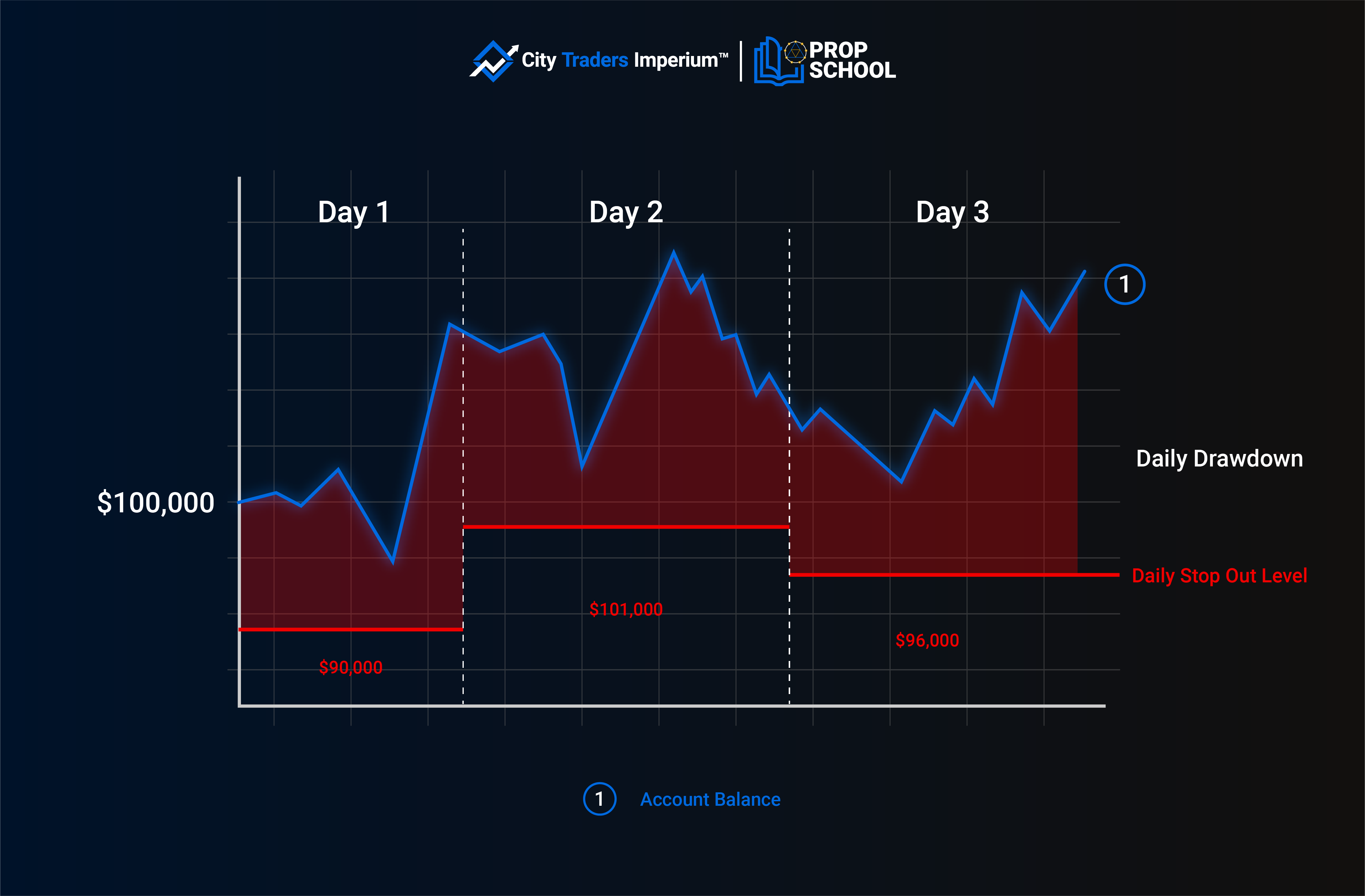
Daily drawdown limits how much you can lose in a single day. If you’re the kind of trader who risks big in one go, this rule can save you from wiping out your account.
Formula
Daily Drawdown = Start of Day Balance – (Initial Balance x 5%)
📌 Example of a Daily Drawdown:
Let’s say your initial account balance is $100,000, and your max daily drawdown limit is $5,000 (5% of $100,000).
If your start-of-day balance is $106,000, your maximum loss for that day is still $5,000 from your start-of-day balance, so you can’t lose more than $5,000 in one day.
This means your stop-out level for the day would be:
$106,000 − $5,000 = $101,000
If your balance or equity drops below $101,000 that day, you would violate the daily drawdown rule.
Why City Traders Imperium Stands Out in 2025?
Since 2018, City Traders Imperium has used a Balance-Based drawdown on all its funding programs. This lets you focus on your long-term success with CTI.
So, we’ve got you covered with funding programs tailored to different drawdown types:
On the 2-Step Challenge: we use an Absolute Drawdown of 10% and a Daily Drawdown of 5%.
On the 1-Step Challenge: we use an Trailing Drawdown of 5% and a No Daily Drawdown.
On the Instant Funding and Instant Funding Pro: we use an Absolute Drawdown of 6% only. This ensures we keep offering simplicity and flexibility without the stress of Daily or Relative Drawdowns.
Why does it matter?
✔️ Trader-Friendly Simplicity: Your drawdown counts only realised losses on closed trades, ignoring floating positions and giving you more recovery room.
✔️ Clear Daily Limits: In the 2-Step Challenge, CTI caps daily losses at 5% — a straightforward safety net for each trading session.
✔️ Flexible and Scalable: With a lower 6% limit for Instant & Direct Funding and a 10% level in the 2-Step Challenge, CTI allows both quick-entry and longer-term growth paths.
✔️ Stress Reduction & Discipline: No surprise stop-outs due to floating equity, enabling focused, disciplined trade planning. START CTI CHALLENGE NOW
Strategies to Stay Within Your Drawdown Limit
Even the best traders hit rough patches. However, the ones who stay funded know how to manage risk proactively. Here’s how to avoid breaching your drawdown limits and protect your capital.
#1 Position Sizing Rules
Proper position sizing is your first line of defence. It ensures no single trade can blow your account.
Best practices:
- Risk no more than 1–2% of your capital per trade.
- Avoid scaling into losing trades — it compounds your risk exposure.
#2 Daily Loss Circuit-Breakers
Set personal daily loss limits at 50% of your firm’s allowed threshold. This strategy will give you a safety margin and reinforce discipline.
How to do it:
- If your firm allows 5% daily loss, stop at 2.5%.
- Use platform alerts or automation to lock you out.
- Journal losses and stop trading after 2–3 consecutive red trades.
This mimics the circuit-breaker approach used by institutional desks to prevent decision fatigue and emotional re-entry.
#3 Tips from Funded Traders
Mindset matters just as much as math. Drawdowns often trigger fear, revenge trading, or overconfidence — all of which can spiral into breaches.
We’ve asked several experienced CTI traders for some tips. Here’s the one quote that describes the psychological factor behind drawdowns perfectly:
“Drawdown isn’t failure — it’s feedback. If you treat it like a data point instead of a threat, you can adjust without panic.” — Jordan B., CTI Funded Trader
Many traders also mentioned the importance of:
- Sticking to your plan — even in a drawdown;
- Taking planned breaks after max loss days;
- Focusing on process over outcome to reduce pressure.
Many traders also mentioned the importance of:
- Sticking to your plan — even in a drawdown;
- Taking planned breaks after max loss days;
- Focusing on process over outcome to reduce pressure.
For more tips from our experienced traders, be sure to join our CTI Community Discord channel.
Frequently Asked Questions
What is a drawdown violation?
A drawdown violation occurs when your trading account drops below the allowed limit set by your prop firm, either in percentage or dollar terms. It usually results in immediate loss of funding or disqualification from a challenge.
Do prop firms reset your drawdown limit if you make a withdrawal?
Some prop firms reset the drawdown limit based on your new, post-withdrawal balance or equity, while others keep it tied to your original funded amount. CTI’s drawdown is fixed and does not trail, so your limit remains constant.
Can I pass a challenge if I briefly hit the drawdown limit but recover later?
No. All Prop firms consider hitting the drawdown threshold a hard breach, even if your account later recovers. The violation usually results in disqualification the moment the limit is exceeded, not based on where you end the day.