
Jumping into the world of proprietary trading can feel like stepping onto another planet.
Which funding program is right for you in 2025?
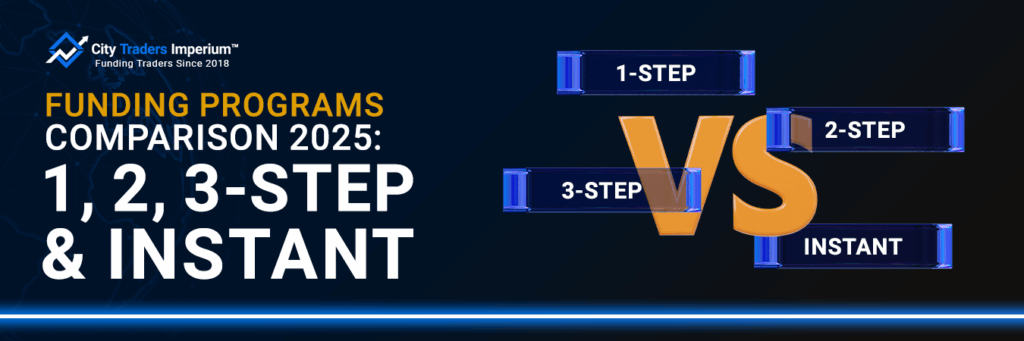
In this Funding Programs Comparison 2025, we’ll demystify the 1-Step, 2-Step, 3-Step, and Instant Funding models. You can then decide which funding model best suits your trading style.
I remember when I first started: I was confused between challenge stages and instant funding, and it wasn’t until I mapped pros and cons side by side that I truly understood the prop firm funding models.
By the end, you’ll know exactly which evaluation process matches your trading style and goals.
Key Highlights
✅ Different traders need different models – There’s no one-size-fits-all; the right funding path depends on your style and risk profile.
✅ Clarity drives better outcomes – Understanding rules, drawdowns, and evaluation phases upfront helps traders avoid failure and frustration.
✅ Fast isn’t always smart – Instant Funding offers speed, but challenge-based models may be better for long-term growth and lower cost.
✅ Funding is a stepping stone, not a shortcut – Success in prop trading requires discipline, planning, and a growth mindset.
✅ CTI is here for every step – Whether you’re just starting or ready to scale, City Traders Imperium provides tools, funding, and support.
Why Funding Models Matter for New Traders
Ever found yourself thinking, “Is this the right funding model for me?”
You’re not alone. Different prop firms structure their funding programs in various ways, and those differences can significantly affect your costs, funding speed, trading style, and risk management approach.
Here are the key areas to consider:
Max Loss Limits
This refers to how much you’re allowed to lose. It includes rules like maximum drawdown, daily loss limits, and trailing drawdowns. These limits affect the amount of risk you can take and the flexibility of your strategy.Speed to Getting Funded
How quickly can you become a funded trader? Some firms offer instant funding, while others require passing a multi-phase challenge. The faster route to getting funded might come with higher costs, so it’s worth weighing the trade-offs.Scaling Plan Potential
Once you’re funded, how much can your capital grow? And whether the type of conditions you need to meet are suitable for your trading style.
I remember when I first tried a Two-Step challenge — I nearly gave up on day one! That’s why understanding these funding models upfront can save headaches (and failed funded accounts).
💡 Pro Tip: The funding model alone isn’t enough. It’s just as important to choose a legitimate prop firm that has been in the business for a long time (ideally, 5+ years) and has realistic, sustainable trading rules. To help you choose the right prop firm, we’ve put together this article on how to select a legitimate one.
Understanding Prop Trading Funding Models
Every proprietary trading firm has its own evaluation process — a way to assess your skills, risk management, and consistency. Broadly, these models fall into four categories:
1-Step Funding: Prove yourself in a single evaluation phase.
2-Step Funding: Pass an initial challenge, then complete a verification phase to qualify for funding.
3-Step Funding: Complete a multi-phase challenge with additional stages — often used by firms that want to see longer-term consistency before offering larger capital.
Instant Funding: You get funded immediately, and have the ability to get paid a profit share without having to go through an evaluation.
These funded trading program models cater to different trading styles.
Are you disciplined enough for a multi-phase challenge, or do you prefer instant access — even if it comes at a little higher cost?
Funding Models Breakdown
The 1-Step Challenge
1-Step funding model is exactly what it sounds like: you pass one phase and you’re funded. Typically, traders pay a single fee, reach a profit target (e.g., 8%), and adhere to a maximum loss limit (e.g., 5%).
Pros of 1-Step Challenge
Lower Profit Target: You only need to pass 1 phase with a relatively low profit target (typically 8%–10%), compared to a 2-step challenge, which often requires hitting 12%–15% across 2 phases.
Balanced Cost: The price-to-value ratio is generally the most balanced among all funding models.
Fee Refund: When you pass the challenge, the evaluation fee is usually refunded.
The 2-Step Challenge Model
The 2-Step funding model splits the evaluation into two phases:
Phase 1 (Pre-Evaluation): Achieve a higher profit target of 8% to 10%.
Phase 2 (Verification): Repeat under similar rules, but with a lower profit target of 5%.
Typically, prop firms offering an 8% target in Phase 1 also include specific rules — for example, using an equity-based drawdown instead of a balance-based drawdown, and restricting trading during high- and medium-impact news events.
Pros of the 2-Step Challenge
Higher Drawdown Limits: The 2-step challenge usually comes with more generous drawdown allowances (8% to 10%) than most 1-step challenges or instant funding programs.
👉 For more details on how equity-based drawdown differs from balance-based drawdown, check out this article: Drawdown Types in Prop Firms.
3-Step Funding Model
Think of 3-Step funding as a 2-Step model with an extra checkpoint, splitting the evaluation into three bite-sized phases.
Each phase carries a modest 6% profit target and enforces the tightest drawdown rules across all funding programs. Once you clear the third phase, you go live with a funded account.
Pros of the 3-Step Challenge
Lowest overall cost: The total fee is often the lowest among all funding programs, as it requires passing three times before being funded. However, this comes at the cost of a higher profit target of 18% (around 6% per phase), and drawdown limits are usually stricter (often around 4%), leaving minimal room for error.
The Instant Funding Model
Instant Funding is like cutting the queue — you get a funded account immediately, with no evaluation phases required. This model lets you trade with the firm’s capital right away. In exchange, you typically pay a higher price compared to challenge-based programs.
Pros of Instant Funding
-
- No Evaluation Stress: Skip multi-phase challenges and jump straight into trading live capital.
- Immediate Access to Payouts: Get funded as soon as you sign up, with the freedom to withdraw profits without needing to pass any tests.
- Simplified Drawdown Rules: Many instant funding accounts use a static drawdown instead of daily loss limits, meaning there’s only one key rule: don’t lose more than the total allowed percentage.
Quick Comparison: One-Step vs. Two-Step vs. Instant Funding
Feature | Instant Funding | 1-Step | 2-Step | 3-Step |
Phases | No Phases | 1-Phase | 2-Phase | 3-Phase |
Profit Target | Profit Targets only for scaling | One Profit Target of 8% | Two Profit Targets of 10%, then 5%. | Three Profit Targets of 6% each |
Drawdown Types | Static Drawdown of 6% | Trailing Drawdown of 5% | Static Drawdown of 10% + Daily Drawdown of 5% Each Phase | Static Drawdown of 4% Each Phase |
Time to get Funded | Instant | Variable (Few days to weeks) | Variable (Few days to weeks) | Variable (Few days to weeks) |
Payout Speed | Instant | After passing the 1st phase | After passing both phases | After passing all 3 phases |
Scaling Plans Options | Performance Based | Time-Based Increases by x% after x months | Time-Based Increases by x% after x months | Time-Based Increases by x% after x months |
How to Choose the Right Funding Program?
When selecting a funding program, think first about risk management and risk tolerance.
Ask yourself: How much drawdown can I handle? Do I prefer tight limits to force discipline, or looser ones that suit a more aggressive approach?
Evaluate Your Strategy & Drawdown Comfort: Look for the 2-Step Challenge or Instant Funding if you want wider drawdown allowances.
Consider Scaling Goals: Instant funding often offers the most aggressive scaling plans, letting you quickly scale up your funded account.
Immediate Payouts: Instant funding allows you to start trading today, and you can request a payout without going through a verification process.
5 Tips to Pass Any Evaluation
1. Draft a clear trading plan: Don’t “wing it.” Have a plan, log your trades, and stick to your rules. If you don’t respect the process, the market will humble you fast.
2. Manage risk: Never risk more than 1–1.5% of your capital per trade. Most failed evaluations aren’t due to bad trades — they’re due to poor risk control.
3. Use demo trials first: Many firms (CTI included) let you try a free challenge. Use this to learn their rules inside out and pressure-test your approach without financial risk.
4. Join communities: Whether it’s Discord, Telegram, or a firm’s internal forum, being around other traders helps. You’ll find emotional support, strategy ideas, and alerts about rule changes or payout policies.
5. Don’t just trade – study: Learn more about prop trading in CTI’s Prop School or CTI Academy
Final Thoughts: It’s Not Just About Getting Funded
Each model comes with its own pace, pressure, and purpose.
Some traders love the challenge of a Two-Step. Others want the simplicity of One-Step. A few are ready for Instant and just need a vehicle to scale.
Whichever path you choose, make sure you treat prop trading as more than a shortcut to capital. It’s an opportunity to grow — not just as a trader, but as a decision-maker, a risk manager, and an entrepreneur.
Try our challenge funding program to test your skills. Or, if you’re feeling confident, apply for our instant funding program.