

Understanding Market Orders vs. Limit Orders in Forex Trading
The forex trading market is an ever-changing environment where the strategic use of different order types plays a pivotal role in executing trades effectively. Two of the most common types of orders used by forex traders to enter or exit a trade in the foreign exchange market are market orders and limit orders. Both of these order types come with their own set of advantages and limitations, catering to distinct trading styles and objectives.
What Is a Market Order?
A market order is a straightforward instruction to buy or sell a currency pair at the current market price. When a trader places a market order, they are seeking immediate execution, prioritising speed over price. Market orders are ideal for situations where certainty of execution is more crucial than the exact price at which the trade is executed.
The main characteristics of market orders are:
- Immediate execution: Market orders will be filled immediately at the market price.
- No price guarantee: Since market orders are executed at the current market price, the exact price at which the order will be filled isn’t guaranteed.
- Assured execution: Market orders are typically filled quickly and completely as long as willing buyers or sellers are on the other side of the trade.
- May experience slippage: In highly volatile markets, the price a market order fills may differ from the last traded price or the price quoted when the order was submitted. This variation in filling price is known as “slippage.”
- Simplicity: Market orders are straightforward and easy to use, making them a popular choice among traders who want to enter or exit positions quickly.

What Is a Limit Order?
Conversely, a limit order allows traders to specify the price at which they are willing to buy or sell a currency pair. This order type provides control over the entry or exit price, ensuring trades are executed at a predetermined level or more favourable price.
The main Characteristics of limit orders are:
- Price control: With a limit order, you can set the specified limit price, which is the maximum price at which you are willing to buy or the minimum price at which you are willing to sell a financial instrument.
- Uncertainty of execution: Unlike a market order, a limit order is not guaranteed to execute, and if the market price fails to reach the limit price, the order will not be filled.
- Partial fills: If there is insufficient liquidity at the specified limit price, a limit order may be partially filled, with the remainder of the order staying open until it’s either filled or cancelled.
- No slippage: Since limit orders are executed at the limit price or better, there is no slippage, which means the price at which the order is filled will not be worse than the limit price you have set.
- Flexibility: Limit orders give traders more control over the price at which they enter or exit a position, allowing them to manage risk and target specific price levels.
Exploring the Four Varieties of Limit Orders in Trading:
Understanding the various types of limit orders in Forex trading—sell limit, buy limit, sell stop, and buy stop—is crucial for any trader. These orders allow traders to enter and exit positions at specific price points, thereby managing risk and maximising potential profits. Let’s delve into each type of limit order and explore when and how they are commonly used in the Forex market.
Buy Limit Order
A buy limit order is an instruction to buy a currency pair at or below a specified price. Traders use buy limit orders when they believe that the price of the currency pair will decrease to a certain level before rising again. It’s often employed when traders anticipate a pullback in an uptrend or a bounce from a support level. For instance, if EUR/USD is trading at 1.1500 and a trader expects the price to drop to 1.1450 before resuming an upward movement, they can place a buy limit order at 1.1450.

Sell Limit Order
Contrary to a buy limit order, a sell limit order is an instruction to sell a currency pair at or above a specified price. Traders use sell limit orders when they anticipate that the price will increase to a particular level before dropping. It’s typically utilised in situations where traders anticipate a retracement in a downtrend or a resistance level to hold. For example, if USD/JPY is trading at 110.00 and a trader predicts the price will rise to 110.50 before declining, they can place a sell limit order at 110.50.
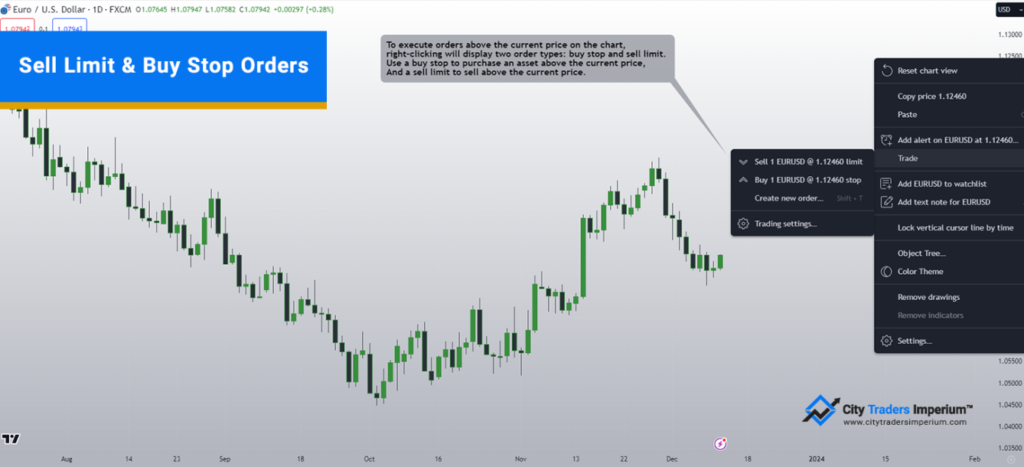
Buy Stop Order
A buy-stop order is placed above the current market price and is triggered when the market price reaches or surpasses the specified stop price. Traders use buy-stop orders to enter a long position when they anticipate that the price will move higher, breaking through a particular resistance level. For instance, if GBP/USD is trading at 1.4000 and a trader anticipates a breakout above the resistance level at 1.4050, they can place a buy-stop order at 1.4050 to enter the trade if the price moves upward.
Sell Stop Order
A sell-stop order, on the other hand, is set below the current market price and becomes active when the market price falls to or below the specified stop price. Traders use sell-stop orders to enter a short position when they expect the price to fall below a specific support level. For example, if AUD/USD is trading at 0.7500 and a trader predicts a breakdown below the support level at 0.7450, they can place a sell-stop order at 0.7450 to initiate the trade if the price drops.
Each type of limit order serves a unique purpose in a trader’s strategy, enabling them to enter or exit positions at predefined prices. Successful traders carefully analyse market conditions and employ these orders judiciously to manage risk and maximise potential profits in the dynamic Forex market.
Similarities and Differences With Limit Orders
Both stop-loss and take-profit orders share some similarities with limit orders. Like limit orders, they allow you to set a specific price level for execution. However, there are also key differences:
- Execution type: While limit orders are executed at the specified price or better, stop-loss and take-profit orders become market orders once the trigger price is reached. This means they are filled at the next available price, which may be slightly different than your desired price.
- Triggering mechanism: Limit orders are triggered by the current market price reaching the specified price level. In contrast, stop-loss and take-profit orders are triggered by your predetermined price level, regardless of the current market price.
- Order duration: Limit orders typically remain active until cancelled or filled. Stop-loss and take-profit orders can be set with a specific expiration time, ensuring they are automatically cancelled if not triggered within a certain timeframe.
Benefits of Using Stop-Loss and Take-Profit Orders
Stop-loss and take-profit orders offer numerous benefits to forex traders:
- Enhanced risk management: They help to limit potential losses and secure profits, providing peace of mind and preventing emotional trading decisions.
- Discipline and objectivity: By setting these orders in advance, you avoid the temptation to change your mind or hold on to losing positions for too long.
- Improved trading performance: By managing risk and securing profits, you can improve your overall trading performance and protect your capital.
Pros and Cons of Market Orders:
Pros:
Execution Speed: Market orders are executed instantly at the current market price, ensuring swift entry or exit from a position.
Certainty of Execution: Traders are guaranteed execution, particularly in highly volatile market conditions.
Cons:
Price Uncertainty: Market orders may be executed at a slightly different price than anticipated, especially during high volatility, leading to slippage.
Vulnerable to Gaps: In fast-moving markets or during news releases, market orders might be filled at significantly different prices due to price gaps.
Pros and Cons of Limit Orders:
Pros:
Control Over Price: Limit orders allow traders to specify entry or exit prices, providing more precise execution.
Mitigating Slippage: By setting a specific price, traders can avoid potential slippage commonly associated with market orders.
Cons:
Potential Non-Execution: If the market doesn’t reach the specified price, limit orders may not be executed.
Missed Opportunities: In rapidly changing markets, prices may not return to the desired level, causing missed trading opportunities.
Scalping and Market Orders
If you’re into scalping, you’ll definitely want to use market orders. Scalping is a fast-paced trading strategy where you’re looking to make a lot of quick trades and profit from small price movements. In this type of environment, speed is everything. You need to be able to get in and out of trades instantly, and that’s where market orders come in handy.
With a market order, you can execute your trade immediately at the current market price. This is perfect for scalping because you don’t want to miss out on any opportunities. For example, let’s say you’re watching the EUR/USD pair, and you see a favourable news release. If you want to capitalise on the initial price movement, you’d place a market order to buy right away. That way, you can ride the wave before the price starts to settle back down.
Swing Trading and Limit Orders
Now, if you’re more of a swing trader, limit orders are going to be your best friend. Swing trading is all about playing the longer game, holding positions for several days or even weeks to capture bigger price swings. In this case, you’re not as concerned about split-second execution. Instead, you want to be strategic about your entry and exit points.
This is where limit orders come in. With a limit order, you can set the exact price at which you want to buy or sell. This gives you a lot more control over your trades. For instance, imagine you’re analysing the daily GBP/USD chart and identifying a key support level. You could set a buy limit order at that level, which means your trade will only execute if the price reaches your specified point. Then, you can plan to sell at a higher resistance level, aiming to profit from the overall price swing.
So, it really comes down to matching the right order type with your trading strategy. Scalpers need the speed and immediacy of market orders, while swing traders benefit from the precision and planning limit orders provide. Most traders combine both order types to varying degrees.
Conclusion:
Market orders and limit orders are both widely used among forex traders, though they serve distinct purposes and suit different trading strategies. Market orders offer speed and certainty of execution but come with the risk of price uncertainty and slippage. On the other hand, limit orders provide control over execution price but may not guarantee execution if the market doesn’t reach the specified level.
Successful traders often employ a combination of both order types, considering market conditions, volatility, and individual trading objectives. Mastering the use of market and limit orders, along with effective risk management through stop loss and take profit orders, forms the cornerstone of a well-rounded forex trading strategy.
Understanding the nuances between these order types empowers traders to make informed decisions, navigate the intricacies of the forex market, and optimise their trading approach for better outcomes.