

What Is a Pip in Forex? The Ultimate Guide
They may sound funny, but ‘pips’ are the ABC of forex trading. Understanding how they work is crucial for anyone who wants to engage in forex trading, let alone be successful.
Put simply, trading forex without knowing how pips work and how to calculate their value is like reading a book without learning how to read.
It doesn’t really work.
Yet, despite it being absolutely vital, many aspiring traders jump headlong into trading without understanding such forex market fundamentals.
There’s no other way around it – if you want to become a successful forex trader who wants to take advantage of one of our funding programs, the first step is to learn what a pip in forex is, how it works, and how to calculate its value.
Understanding Pips in Forex
So, what is a pip in forex?
‘Pip’ is an acronym for percentage in point (or price interest point). It’s the standardised unit of measurement used in forex to express the change in the value of a currency pair.
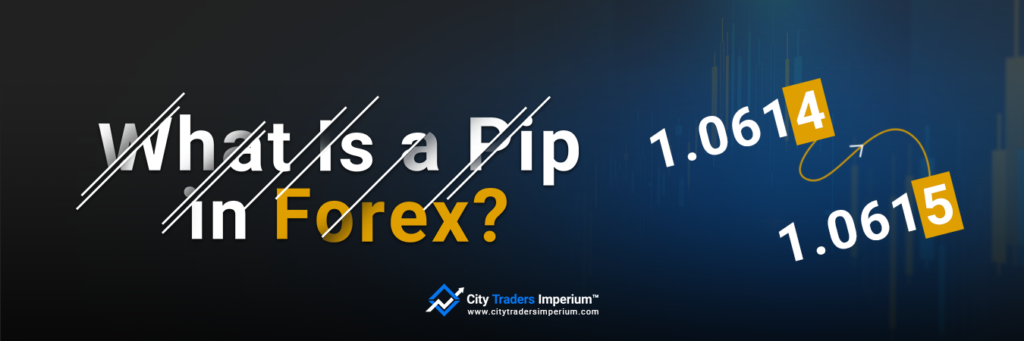
For example, let’s say a standard EUR/USD pair moves from 1.0854 to 1.0855. It means that the USD rose by .0001 in value. That value is your 1 pip.
In other words, a pip is the fourth decimal point in currency price.
There are, however, some exceptions to this rule, with the most prominent one being Japanese yen (JPY) pairs. The catch here is that JPY pairs are quoted with 2 decimal places, meaning that a 0.01 price move will be referred to as one pip instead of the standard 0.0001 change.
Pips vs. Pipettes
You may have noticed that some forex brokers quote their currency pairs at 5 or 3 decimal places instead of the standard 4 and 2. That’s because they use fractional pips, called ‘pipettes’ or ‘points.’
What the heck is a pipette? We won’t keep you in suspense; it’s a tenth of a pip.
For example, if a broker quotes the EUR/USD pair at 1.08546 (five decimal places instead of four), and that price moves to 1.08545, it means there’s been a 0.00001 change. We then say that the price moved by one pipette.
A similar rule applies to JPY pairs, where a pipette is the third decimal point in the currency pair quote.
The Relation Between Pips and a Spread
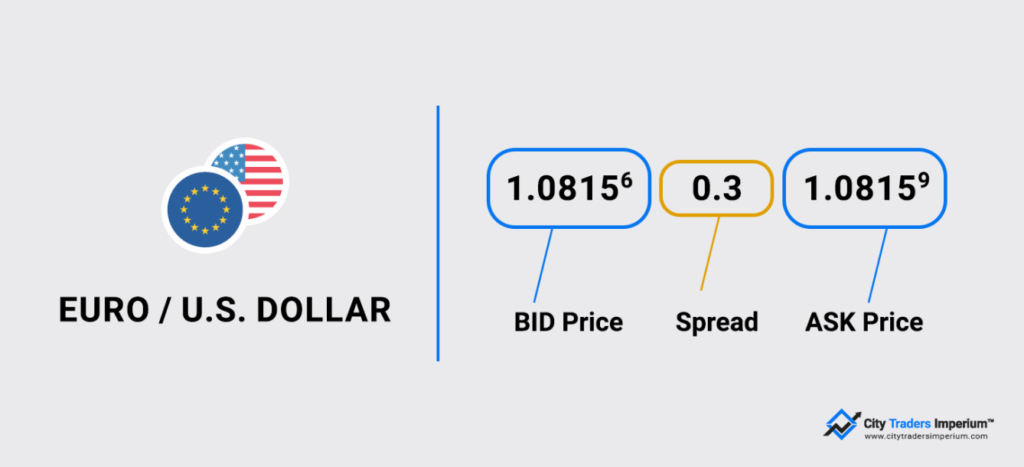
Spreads in forex refer to the difference between the bid and ask price of a currency pair. Simply put, it’s a bid price subtracted from the ask price.
Why are we mentioning them? Because spreads are also measured in pips.
For instance, if the USD/JPY pair’s ask price is 150.46 and the bid price is 150.48, the spread is 0.2, aka 2 pips. We can also say that the USD/JPY pair has a 2-pip spread.
The image below displays the BID price positioned on the left side, the ASK price on the right, and the spread, illustrated in the middle, represents the variance between them which is the spread.
How to Calculate Pip Value?
Okay, we know what pips in forex are. Now, let’s learn how to calculate their value.
The value of a pip is affected by three primary factors – the currency pair, exchange rate, and trade size.
To calculate the pip value, we use a simple formula:
currency pip value = (pip size/exchange rate) * position size
Let’s go through three simple examples:
1st Example: AUD/USD at 0.6514
Let’s say you have a USD brokerage account, and you want to trade 100,000 units of AUD/USD. How much is one pip worth in such a scenario? Let’s do the maths:
0.0001 * 100,000 = $10
Note that there’s no exchange rate. That’s because if your account currency is the U.S. dollar and the USD is the quote currency, the pip is fixed at 0.0001. So, for instance, if you buy 100,000 AUD against the USD at 0.6514 and sell at 0.6517, your profit would be $30 as the price moves up by 3 pips.
2nd Example: USD/CAD at 1.3692
In this case, USD is the base currency and your account currency, meaning that your pip value will be influenced by the exchange rate. So, for a trade worth 100,000 units of USD/CAD, the pip value would be:
(0.0001/1.3692) * 100,000 = $7.30
In such a case, each pip movement is worth $7.30. So, if you were to buy 100,000 USD against the dollar at 1.3692 and sell at 1.3690, you’d lose $14.60.
3rd Example: EUR/JPY at 163.35
Let’s see how to calculate the pip value when JPY is involved. Suppose we want to trade 100,000 units of EUR/JPY:
(0.01/163.35) * 100,000 = €6.12
In this case, every pip movement is worth 6.12 EUR. So, if you bought 100,000 EUR against JPY at 163.35 and sold it at 163.39, it means the price moved by 4 pips, translating to a profit of €24.48.
Why Is It Important?
By now, you should be able to tell what pips are, how they differ from pipettes, their relation with spreads, and, more importantly, how to calculate their value. At this point, the only question you may have is why?
Why have we forced you to go through all this? Are pips really that important?
Yes, they are.
As we stated at the beginning, trading forex without pips is like reading without learning how to read.
After giving it some thought, we’d say that a better way to put it would be reading a book in a foreign language without knowing it – you might be able to understand some things, but you’d never be able to tell what the book is about.
Calculating pip value enables forex traders to make informed trading decisions by helping determine the risk of a trade. Essentially, a pip value tells you how much each, even the tiniest price movement, can affect your profits and losses.
Based on that, you can more accurately judge how to place your entry and exit points to yield higher profits or minimise potential losses.
Without this information, you might as well flip the coin to decide whether to enter a trade or not and when to exit it.
The Bottom Line
Understanding what a pip in forex is and learning how to calculate its value is the first step in becoming a good forex trader. It’s one of the fundamentals every trader must learn if they’re serious about their forex trading.
What are the next steps in your forex trading journey? Well, once you understand the basics, it’s time to start trading. Regarding forex, practice is the best teacher, allowing you to test various strategies and learn the ropes.
For more guidance, be sure to join our CTI Academy, which covers all the ins and outs of forex trading. And if you believe you’re ready to start trading, we encourage you to try our Challenge Trader Program.
Either way, learning how pips work is a good first step.