

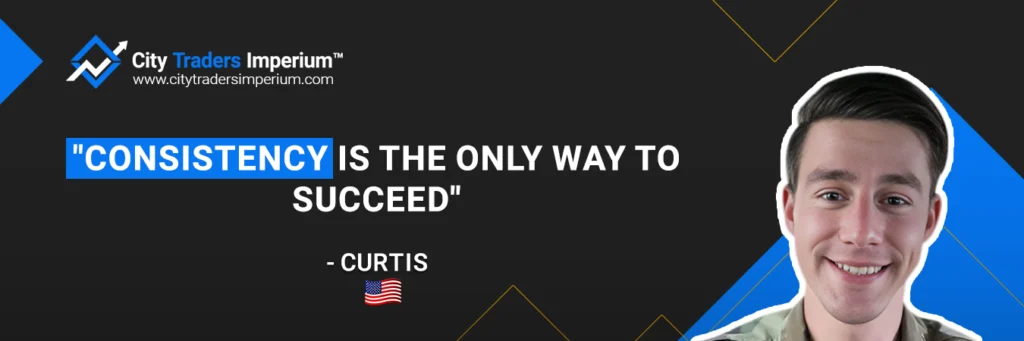
Curtis, a member of the American Air Force, shares his journey from trading options during the pandemic to becoming a disciplined Forex trader. Curtis emphasizes the importance of risk management, patience, and stepping away from overtrading.
His experience shows that even while balancing a demanding job, success in trading comes from understanding the markets, applying a structured strategy, and maintaining emotional control. His key to passing the CTI evaluation? Proper risk management and staying consistent with his trading process.
| Field | Details |
|---|---|
| Program | CTI Evaluation |
| Result | PASSED ✅ |
| Win Ratio | 51% |
| Relative Drawdown | 2.65% (High discipline) |
| Risk-to-Reward | 1:3 Target |
| Risk Management | 0.25% – 0.50% (Conservative challenge approach) |
| Asset Focus | EUR/USD, GBP/USD, EUR/GBP, GBP/JPY |
| Strategy | ICT Mentorship Concepts |
| Background | U.S. Air Force Professional |
| Validation | ✅ Validated by CTI Risk Team |
Key Challenges
Overleveraging and Impatience:
Curtis faced one of the most common challenges for new traders—overleveraging. Initially trying to grow his account quickly, he realized that high risk often leads to quick losses.Overtrading and Emotional Decisions:
Spending too much time on the charts led Curtis to overanalyze, second-guess his trades, and enter trades impulsively. This negatively impacted his consistency.
Turning Point
Curtis’s breakthrough came when he understood that trading is about consistency, not about making fast money. By adopting a disciplined approach, reducing his risk to 0.25-0.5% per trade during the CTI evaluation, and focusing on smart money concepts, Curtis developed a mindset that helped him overcome his earlier habits of overleveraging and emotional trading.
Strategy and Approach
Curtis primarily follows a smart money concept-based strategy inspired by the ICT (Inner Circle Trader) mentorship. His approach focuses on:
- Identifying imbalances in the market and trading around order blocks.
- Targeting 1:3 risk-to-reward ratios.
- Trading pairs like EU, GU, EG, and GJ.
By reducing risk and waiting for confluences, Curtis found a balance between discipline and taking calculated risks, which ultimately led to his success in the evaluation.
How He Overcame His Challenges
Lowering Risk:
During the CTI evaluation, Curtis reduced his typical risk from 1% to 0.25-0.5%, ensuring that any losses were manageable and didn’t impact his psychology. This approach allowed him to avoid emotional trading and maintain focus on the long term.Stepping Away from the Charts:
Curtis realized that spending too much time in front of the charts led to forced trades. By limiting his screen time, he avoided overanalyzing and maintained a more objective view of the markets.
Current Process and Success
- Curtis keeps his trading focused on three to four key pairs, primarily EU, GU, EG, and GJ.
- He targets a 1:3 risk-to-reward ratio, ensuring that his wins are larger than his losses.
- He maintained a win ratio of 51% during the evaluation and kept his relative drawdown at an impressive 2.65%, demonstrating strong risk management.
Key Takeaways for Traders
Avoid Overleveraging:
Trying to grow your account too quickly with high risk will likely lead to inconsistency. Proper risk management is the key to long-term success.Limit Screen Time:
Spending too much time in front of the charts often leads to overtrading. Step away and wait for the right setups to avoid making impulsive decisions.Focus on Process, Not Profits:
By following a consistent, process-driven approach and avoiding emotional decisions, Curtis achieved success in the CTI evaluation and continues to apply these principles as a portfolio manager.