

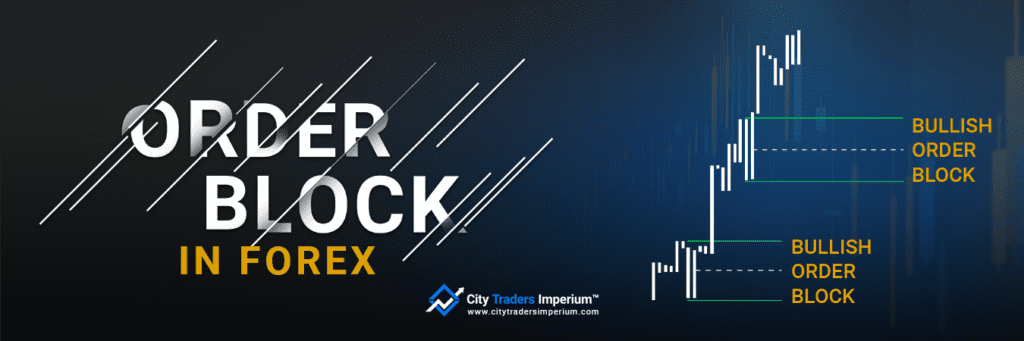
Order blocks are like hints that tell us when big banks and other important big players are planning to make a big move in a certain forex market. The Central Bank is the main boss who controls how prices will move, so it’s important for traders to keep an eye on what they’re doing. When an order block forms, the market takes a little break, moving up and down. This is when important choices about buying and selling are made. When the order block completes forming, the market usually jumps in one direction or the other. The trick to understanding order blocks is knowing that they show what the big players in the market are doing. Using order blocks in trading can help you figure out when to jump on a trade and make your chances of winning even better. So, in this article, we’ll share some tips on how to use order blocks the right way and when you shouldn’t use them. Also, we’ll share 4 helpful guidelines to include in your order block trading strategy plan. If you want to build these ideas into a broader trading framework, City Traders Imperium provides structured education around market behaviour, liquidity, and execution.
Key Findings
- Order blocks denote institutional accumulation/distribution zones where banks layer orders incrementally, preceding sharp liquidity-seeking moves in forex.
- Supply-demand logic is moot in currency markets; central-bank-driven pricing makes order-block behaviour distinct from commodity S-and-D zones.
High-probability blocks occur in trends on 1 H+ charts, overlap fair-value gaps, and trigger swift reactions; consolidation-range blocks frequently fail. - Bullish block = last down candle pre-impulse; bearish block = last up candle pre-drop; trade with stops beyond block and targets at liquidity pools.
- Blocks signal potential but not certainty—combine with confirmation tools, debunk reversal guarantees, and expect longevity while institutions manage large flow.
What is an Order Block in Forex?
An Order Block is a technical analysis technique that tracks where big players are more likely to place their orders. In other words, it is an area or a sign where big institutions would pile up their orders to enter the market around areas called Order Blocks. Yet, when banks want to place their orders, they don’t place one order with a large volume all at once, and they do not randomly place their order at any price. Instead, they place their orders at specific price levels around these order blocks, and they do it incrementally. It allows them to enter their trades at multiple optimal price levels. This lets them place their orders at the best prices a few times without triggering large price movements. Instead, they enter a few smaller positions. For traders who want to practice reading this kind of price behavior before attempting a full evaluation, CTI also offers a free trial prop firm experience.
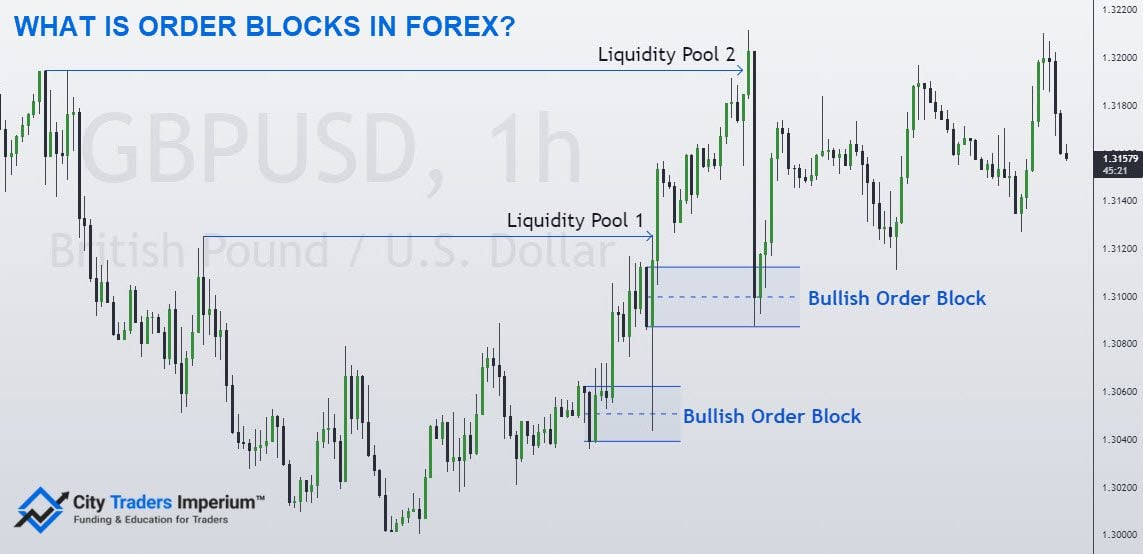
When the price ranges, the Central Bank holds the price in consolidation allowing big players to place their orders. After the price leaves the order block, the price tends to move sharply above old highs (when bullish) and below old lows (when bearish), allowing big players to exit the market with a profit at zones of liquidity. So, given that we have the right direction in mind, we can also enjoy these price movements and profit if we learn how to use Order Blocks to our advantage. That kind of discipline becomes even more valuable when your goal is to pass a funded account challenge and trade with a repeatable edge under defined rules.
Are Order Blocks in Forex the same as Supply & Demand?
Some sources state that Order blocks are specific types of Supply and Demand Zones when Order Blocks are forming, which looks like a range. But this logic is faulty, and here is why. Supply and Demand are only real in the commodity market where real Goods are in demand or supplied, such as Wheat, Corn, Soybean, Oats, etc… Whenever there is a decrease in supply, the price increases and whenever there is an increase in Demand price decreases.
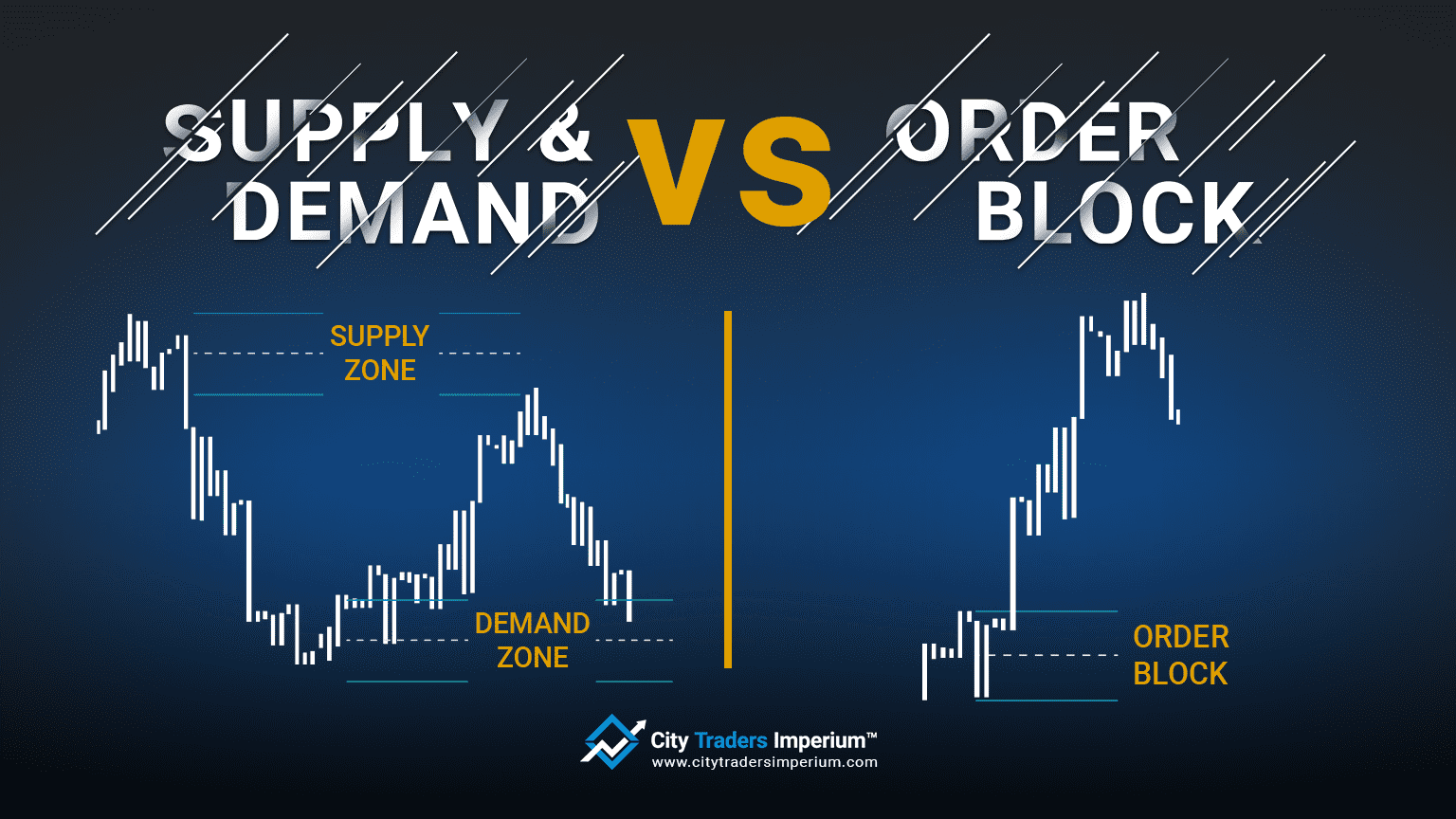
But in forex, the Central Bank controls Currency prices worldwide by computer algorithms and policies. Since the Central Bank has the power to control and manipulate prices, Supply and Demand Zones do not cause prices to react to certain levels. Also, with the Central Bank’s ability to print as much money as it needs, the Supply and Demand Zone logic flies out of the window. So for the reasons above, the price in forex (and CFDs in general) does not move because of Supply and Demand factors. The Supply and Demand Logic in Forex fails to explain why order blocks form and are not the same or similar.
How Order Blocks Form?
So, let’s see how it works.
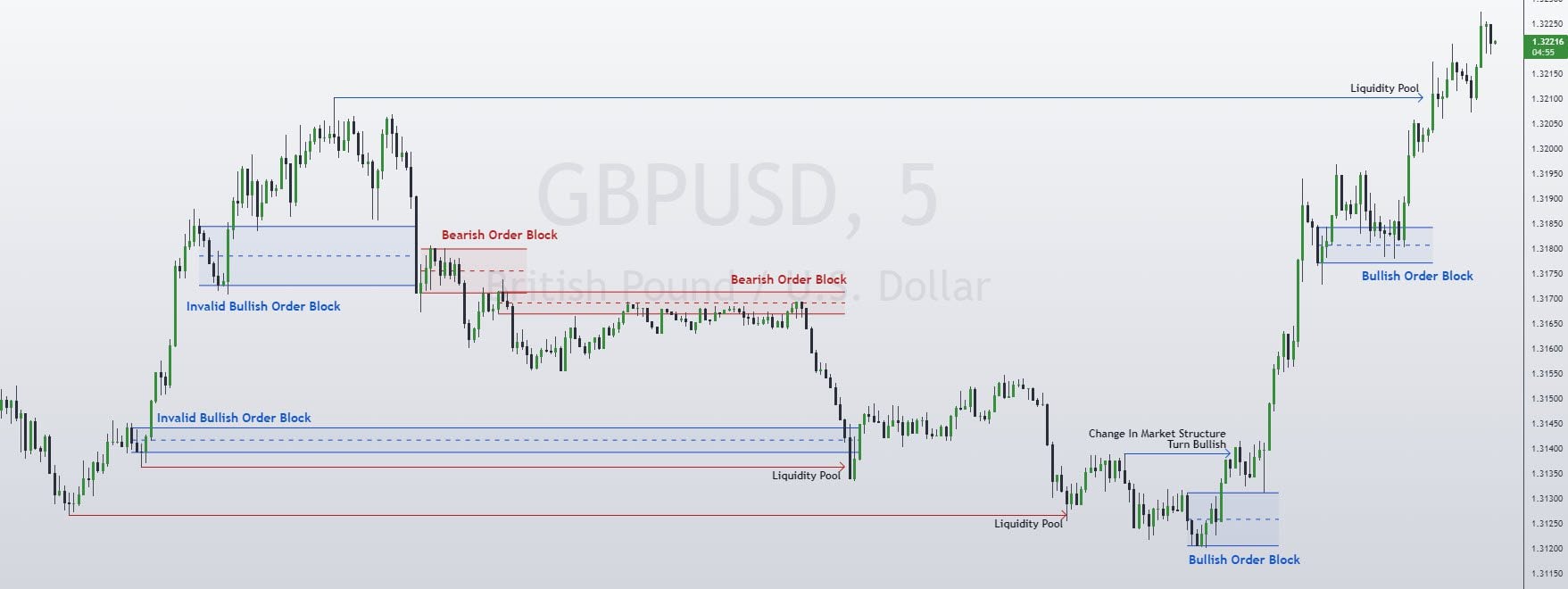
Let’s say the market is bullish, and Financial Institution wants to place their orders to buy GBPUSD. They do it in steps by placing their orders around Order Blocks in anticipation of the price moving higher. These Order Blocks are “Accumulation” areas because Orders are being accumulated around them. Once the price leaves the Order Blocks areas, those same Order Blocks become points of reference to place more buy orders. And this process happens regardless of Supply or Demand factors. The price moves because it seeks liquidity or a group of sell orders that are present above old highs. This allows those Financial Institutions who bought at the Order Blocks to sell their orders to willing sells. Here is a video we prepared to help you better understand Order Blocks.https://www.youtube.com/watch?v=L0i5Fcey5MUOrders at large institutions are done by traders who trade on a client’s behalf, called “Agency Traders”. They do not have as much freedom as Prop Traders have when it comes to making trading decisions. Let’s say Goldman Sachs wants to place a Buy order of 500 million on GBPUSD, but only 100 million would be filled. This is due to liquidity. For every Buy order, there must be a Sell order from a counterparty. So, the transaction of all buy and sell orders in the market from liquidity. Goldman will not be able to execute all their 500 million in 1 trade. There might not be enough liquidity or sellers who are willing to sell to them all the 500 million at this specific price. Instead, they would split their orders into chunks or blocks and execute them at different market price levels. Splitting Goldman Sach’s 500 million orders into a series of smaller positions allows those orders to be filled and executed at the best price possible without disrupting the market. Since Order Blocks are often used by big financial institutions when they trade, it makes sense that regular traders, like you and me, consider using order blocks as well. By using the same ideas that the big players use, we can make more informed decisions and improve our chances of success in trading.
How to find Order Blocks in Forex Trading?
Order Blocks in Forex often show up right before a strong price movement up or down. When the price leaves the Order Block range and forms a big move, it usually comes back into the range to collect more orders. To spot an Order Block, look for the big move and then draw a rectangle from the top to the bottom of the Order Block area. Extend this rectangle to the right. Keep an eye on the Order Block area where the price is likely to return to (this is usually between the 62% and 79% Fibonacci Levels). When the price reaches the top of a Bullish Order Block or the bottom of a Bearish Order Block, that’s when you can make your trade. Remember this tip: for the Order Block to be valid, the price should not close below the middle of the Order Block Range.
Bullish and Bearish Order Blocks
Bullish Order Blocks
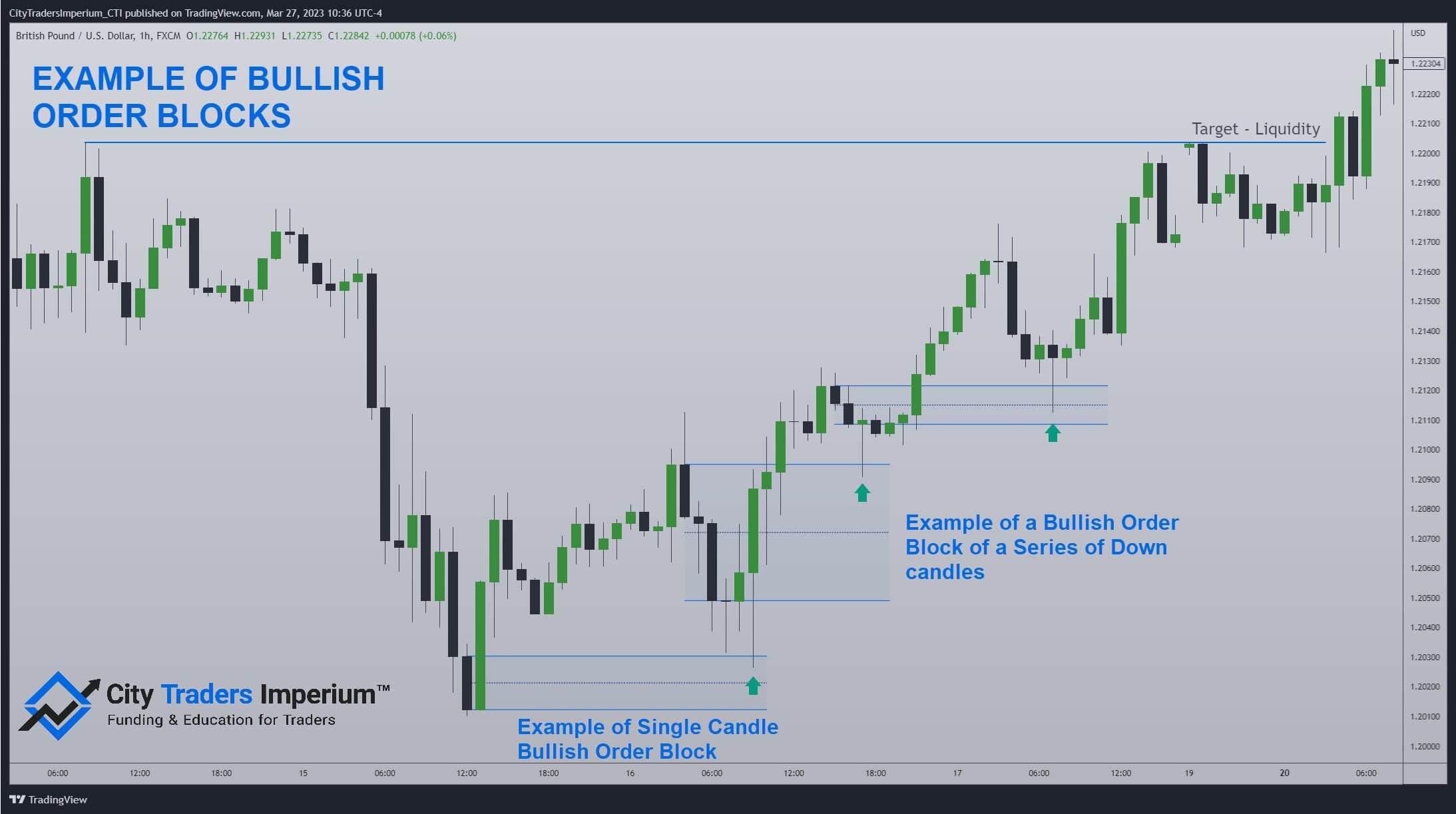
A Bullish Order Block is the last down candle or series of down candles before an impulse price move up. A Bullish Order Block will act as a support for the price to run higher.When the trend turns Bullish, you should only look for Bullish Order Blocks. Once entering a Buy trade, place the stop loss below the low of the Bullish Order Block. Then aim for the price target of the Liquidity Pools above the old highs.
Bearish Order Blocks
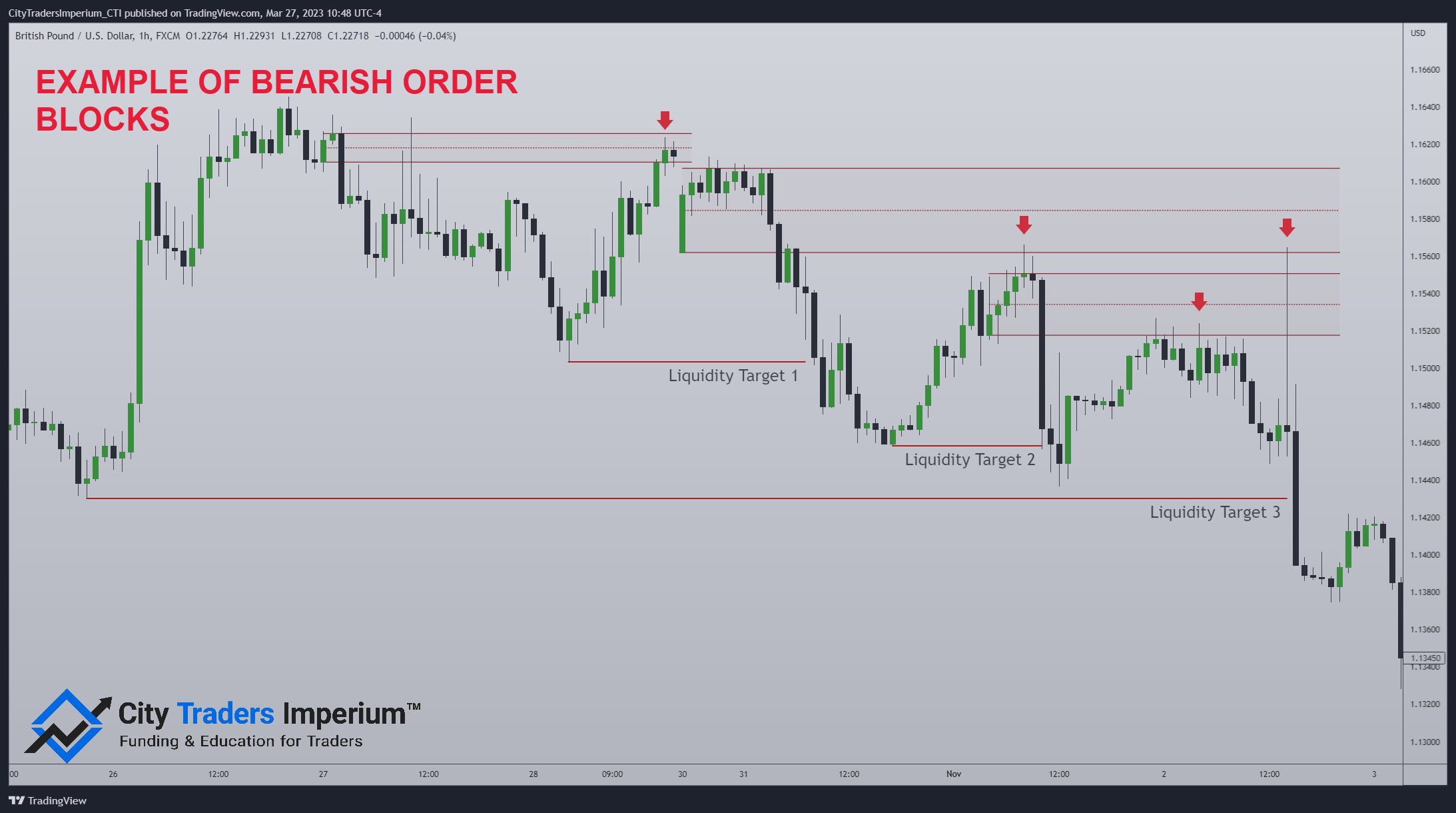
A Bearish Order Block is the last up candle or series of up candles before an impulse price move down. A Bearish Order Block will act as a resistance for the price to run lower.When the trend turns Bearish, you should only look for Bearish Order Blocks. Once entering a Sell trade, place the stop loss above the high of the Bearish Order Block. Then aim for the price target of the Liquidity Pools below the old lows.
High Probability Order Blocks in Forex Trading
The good news is you are now aware of the benefits of knowing about forex Order Blocks and why they form. Yet, finding the High Probability Order Blocks can be a little challenging for traders new to Order Blocks. This has been one of the main reasons why many fail to find high probability order blocks despite their popularity in recent years. For this reason, we will provide you with rules to help you choose high probability Order Blocks.
1. Identify the Current Market Environment.
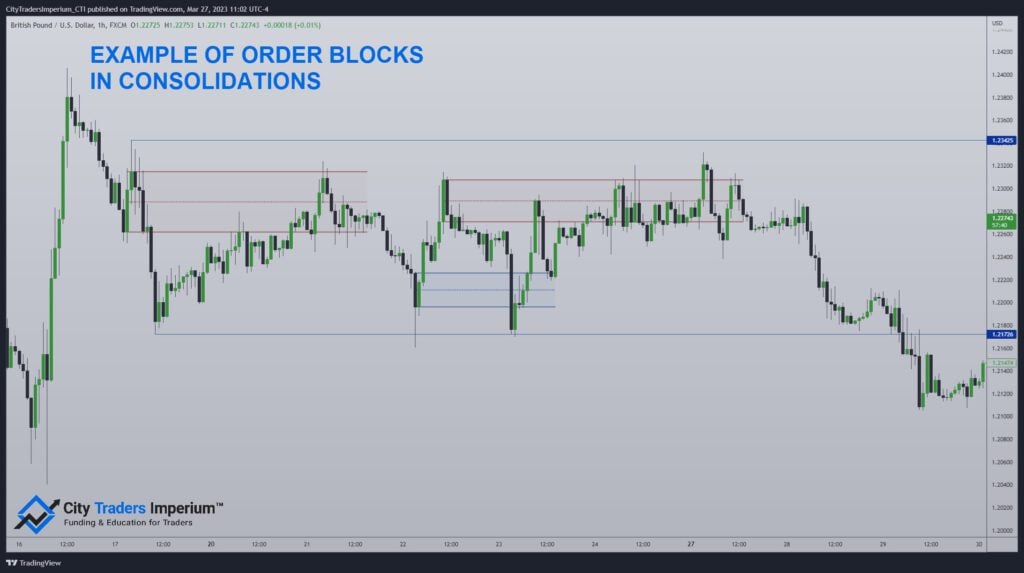
Order Blocks appear in trending and ranging markets, but how to use them is a little bit different in each market. Order Blocks tend to fail more often in a ranging market or consolidations. This is because Order Blocks form inside the range, but the price tends to run old highs and lows in consolidations and not respect the order blocks. In a trending market, prices respect Order Blocks more often, which makes them high probability. This is because big players are involved in trading when the market is trending. And when the market is in consolidation, they stay on the sidelines. As you can see below, Order Blocks in consolidations are Low probability, and they tend to fail more often than not.
2. Use Higher Timeframes
Higher timeframes have more weight and influence than smaller timeframes. This is because most large institutions and professional traders trade at least on the 1H timeframe and above. So, the price is more likely to respect a 1H or 4H Orderblock than a 1 Minute orderblock.
3. User Orderblocks that are in combination with Fair Value Gaps.
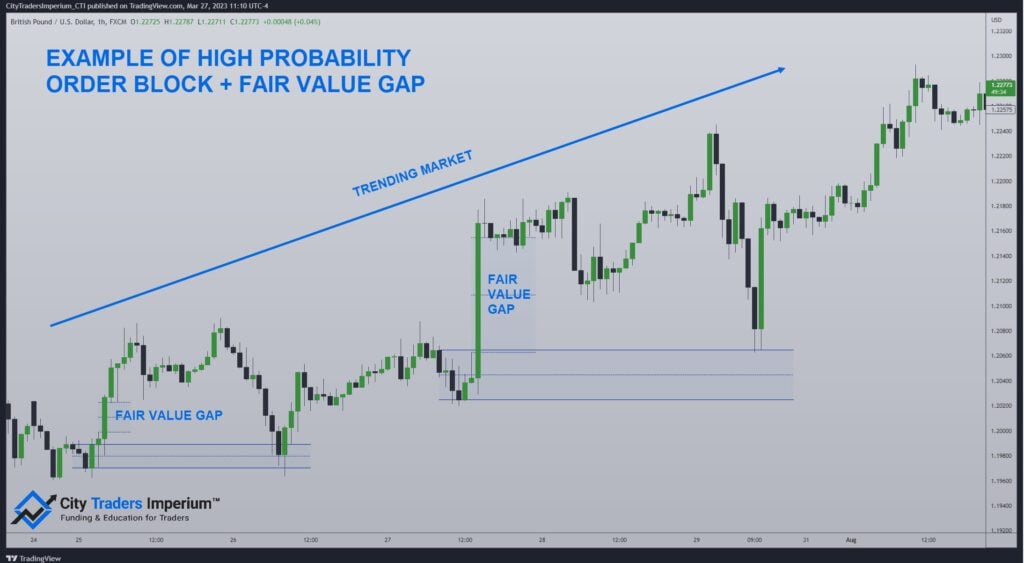
A Fair Value Gap forms as a result of one large candle in a certain direction. It is the price range between the high of the previous candle and the low of the next candle that will form. When an Order Block forms with a Fair Value Gap to its right, this makes it a high probability Order Block, and the price will react at the Order Block. However, when an Order Block does not have a Fair Value Gap to its right, this makes it a low probability Order Block. This is because when an Order Block does not have a Fair Value Gap, the Order Block tends to fail, and the price tends to run the stops below the Order Block.
4. Time it takes for the price to react off an Order Block
If there are orders around the Order Blocks, you should see the price moving away quite fast or in a short period of time – relevant to the Order Block timeframe. If you don’t see any reaction in price, then it’s most likely that this Order Block is not a high probability. The price should not stay for a long time once it reaches the Order Block. If it does, then it’s more likely that you picked the wrong order block.
Will Order Blocks Stop Working?
Some traders might worry that Order Blocks could stop working eventually. But we’re here to say that they will keep working as long as big financial institutions are using them. These big players want to make lots of money, and they don’t really care about small traders like us. Think about it… Even with cryptocurrencies, which are supposed to be decentralized, you can still find Order Blocks. You can also find them in stocks and commodities. So, you should not fear that Order Blocks will stop working. They are just a way to see what’s really happening behind the scenes with Large Financial Institutions. As long as the Central Bank controls the price using its algorithm and offers it to big financial institutions to place lots of orders, Order Blocks will keep forming. So, this is actually a great opportunity for retail traders. If we understand how to use Order Blocks in Forex and Liquidity, it will help fine-tune our trades and maximise our profits.
Some Common Order Block Myths
There are a few prevalent myths surrounding Order Blocks Forex Trading, it helps to drop any misconceptions.
Let’s clear up some inaccurate assumptions:
Myth 1: Order blocks guarantee a reversal.
Reality: Order blocks act as potential turning points but don’t guarantee a reversal. Look for confirming signals.
Myth 2: Any close beyond an order block is highly significant.
Reality: Closes above or below order blocks don’t necessarily generate major moves. Seek confirmation.
Myth 3: Order blocks work equally well in all market conditions.
Reality: Order blocks seem more effective during trends versus choppy periods. Adapt your strategy.
Myth 4: Order blocks are all you need to make trading decisions.
Reality: Combine order blocks with other analyses for best results.
So the reality is that unrealistic hype exists around order blocks. View them as a useful piece of the puzzle, not a stand-alone solution. With measured expectations, you can use order blocks successfully as part of a complete trading plan.
Including Order Blocks in Your Forex Trading Strategy
Lots of traders have different ideas about how to use Order Blocks in their trading. The good news is that you don’t need to be an expert in Smart Money Concepts to take advantage of Order Blocks.
You can use Order Blocks with chart patterns or other indicators to improve your trades. This gives you an extra advantage and will make your strategy even better. The key is combining Order Blocks with a high probability setup you’ve already developed instead of trading Order Blocks by themselves.When used correctly, knowing how to find and use Order Blocks can really help you gain an edge in your trading.
Forex Order Blocks Summary
In conclusion, Order blocks show the accumulation of orders by large financial institutions, and they can be either bullish or bearish. In forex, banks use order blocks to divide their large orders into smaller pieces. This allows them to fill their orders at more favourable prices without disrupting the market structure. They are also an important concept in Forex; understanding them can help traders make more informed decisions. This is because Order Blocks continue to play a significant role in institutional trading. By learning how to use Order Blocks or combining them with other trading strategies, traders can enhance their trading results and maximize profits. So, whether you’re a seasoned trader or just starting out, incorporating Order Blocks into your trading toolkit can provide you with an extra edge in the competitive world of trading.