


Intro to Order Flow Trading
Imagine watching massive buy orders stack up seconds before a breakout, while other traders stare at lagging indicators.
You’re tired of getting stopped out by “fake” breakouts. You want to see what institutional traders see: the actual buying and selling pressure behind every price move. Order flow trading gives you that X-ray vision into market mechanics.
While most traders rely on price charts alone, you’ll discover how to read the real-time battle between buyers and sellers. This guide breaks down order flow analysis into actionable steps and practical tools you can use today. For traders who want to build that skill into a broader trading framework, trading education at CTI also focuses on liquidity, institutional behavior, and execution.
Order Flow Key Findings
- Order Flow trading tracks live buy–sell imbalances in the order book to forecast short-term price direction more precisely than standard chart-based analysis.
- Authentic data comes only from exchange DOM/Level 2 feeds. Decentralised forex and most CFDs offer no actual order book, limiting the accuracy of Order Flow in those markets.
- Key tools include the DOM, volume profile (PoC, HVN/LVN), institutional supply and demand zones, CFTC COT reports, and footprint charts that map trade size by price.
- Popular strategies include bull/bear trap fades, stop-run reversals, liquidity sweep fades, and delta divergence breakouts.
- Benefits: precise entries and early reversal signals.
- Drawbacks: high platform costs, rapidly changing data, and limited access in non-exchange markets.
What Is Order Flow Trading?
Order Flow Analysis, according to Bookmap, is:
“The technique of observing and interpreting the real-time flow of buy and sell orders, including their size and aggressiveness, to predict immediate future price movements.”
Unlike traditional technical analysis, which shows completed price action, order flow reveals these intentions before they impact the price.
This data primarily originates from the Order Book, a matching engine that connects orders of buyers and sellers at incremental price levels. The central bank offers a price to traders to fulfil their orders at certain prices it believes are a fair value for the entity placing the orders.
For instance, let’s assume 100 lots of buy orders and 50 lots of sell orders sat at a specific level. The 50 lots of the buy orders would get filled at that price (from the 50 lots of sell orders). Afterwards, the order book would look to fulfil the remainder at the next available price. The same would happen if there were 100 lots of sell orders and 50 lots of buy orders (just in reverse).
This activity summarises Order Flow trading in a nutshell.
It’s an ever-evolving approach to gauge the interest of bulls and bears based on the addition and removal of positions at specific levels.
Traders look for a potential imbalance of orders to work out the next direction. The market is in constant flux, processing orders from one side to the other. For traders who want to practise applying this kind of market reading before committing to a full evaluation, CTI also offers a free trial.
💡 Pro Trader Tip: Order flow gives you a 5–15 second head start over chart-based traders. Use this edge to nail entries and exits just before key moves, especially near support and resistance. |
How the Order Book Works
The order book, also known as DOM (Depth of Market), is a powerful tool for real-time analysis. It displays live buy and sell limit orders at various price levels, helping traders gauge supply, demand, and market intent before trades are executed.
A typical DOM shows:
- Bid orders (buy side) on the left,
- Ask orders (sell side) on the right,
- With the current market price highlighted in the centre.
By observing how these stacks change in real time, you can detect shifts in buying or selling pressure and identify potential reversal or breakout zones.

Understanding Liquidity vs. Volume
One key concept that catches newer traders off guard: liquidity is not the same as volume.
- Liquidity = pending limit orders in the DOM (not yet executed).
- Volume = actual completed trades (executed buy/sell orders).
A level can show high liquidity but zero volume if no trades are filled. Alternatively, the volume might spike after liquidity is absorbed and thins out. Understanding both is critical for anticipating where price is likely to pause, reverse, or accelerate.
- Liquidity zones indicate potential support and resistance levels.
- Volume spikes reveal confirmed interest and activity.
Forex and CFD Order Flow Limitations
Here’s where many traders get frustrated: spot forex has no central Order Book. It’s a decentralised market — there’s no single exchange, and prices are quoted independently by different participants.
Instead, brokers rely on liquidity providers — large institutions (such as banks, hedge funds, or prime brokers) that supply bid/ask prices and handle execution behind the scenes.
When your broker shows you an “order book” for forex, it usually reflects:
- Internal client positioning (what other customers are doing)
- Aggregated data from their liquidity providers
- But not the full market’s depth or intent.

This makes traditional order flow analysis in forex less reliable. You’re seeing only a partial, synthetic view of the true flow of orders.
That’s why many professional traders who use Order Book Data trade on futures markets, such as EUR/USD futures on the CME, where full order book data is available.
CFDs face similar problems. Although they might show you exchange-based prices, your trades don’t interact with the exchange. Instead, you’re trading against your broker’s internal book, often with no visibility into the real market depth.
💡 Pro Trader Tip: Look for iceberg orders — large institutional trades split into small, repeated orders at the same level. If a size refreshes again and again, that’s not a coincidence. It’s a clue that big players are active. |
Core Order-Flow Tools
To use order flow trading effectively, you need the right tools.
Here are the five essential instruments that reveal market mechanics.
DOM (Depth of Market)
The Order Book or Depth of Market (DOM) should form the basis of any Order Flow trading strategy. This electronic list shows buy and sell orders at incremental prices. Basic order books display limit orders, while advanced versions include market orders and stop-loss orders.
A limit order waits for execution at a specific level. The DOM displays these pending orders on both sides with quantities at each price.
Let’s look at Binance’s order book on Bitcoin or BTC/USD (note the section boxed in blue).

The price in the middle of the box is the current price. The prices below (in green) are the buy limit orders at gradual levels, where we can see their quantity in BTC and total units. We can see the same for the sell limit orders (in red) opposite the current price.
These limit orders fluctuate every second because new ones get added or removed as the price changes.
Footprint Charts
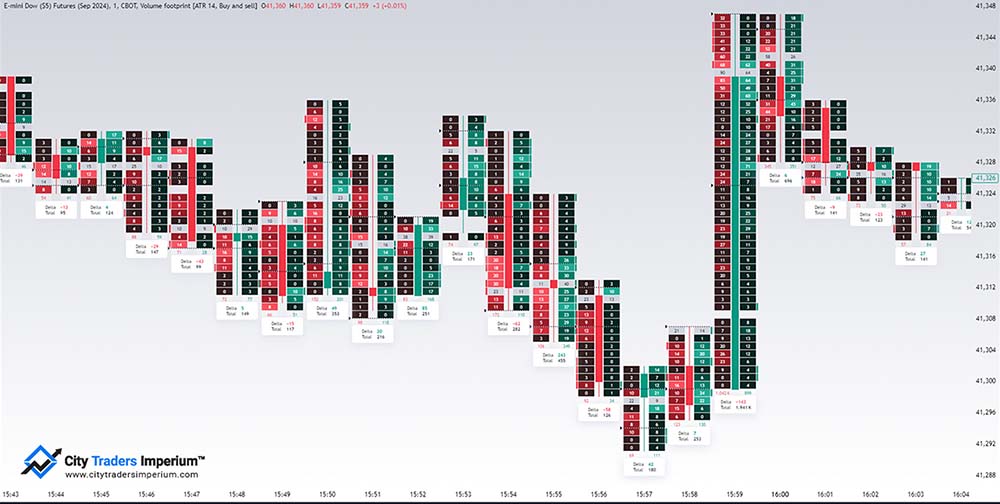
Footprint (or cluster) charts display the volume of executed trades at specific prices within each candlestick.
Footprint charts reveal “buying and selling pressure at specific price levels, offering deeper market insights than traditional candlestick charts.”
Key components include:
- Delta: The difference between buying and selling volume, indicating market sentiment.
- Point of Control (POC): The price level with the highest traded volume, often acting as a magnet for price action.
Here’s a quick look at what these popular order flow trading charts look like:
Reading Order Flow in Volume Profile
The Volume Profile is a technical tool that depicts volume at particular price zones using horizontal histograms.
The idea is to enter at prices where there is a great level of activity. These places act as support and resistance zones when considering the distribution of Order Flow.
Below is a chart with the Volume Profile.
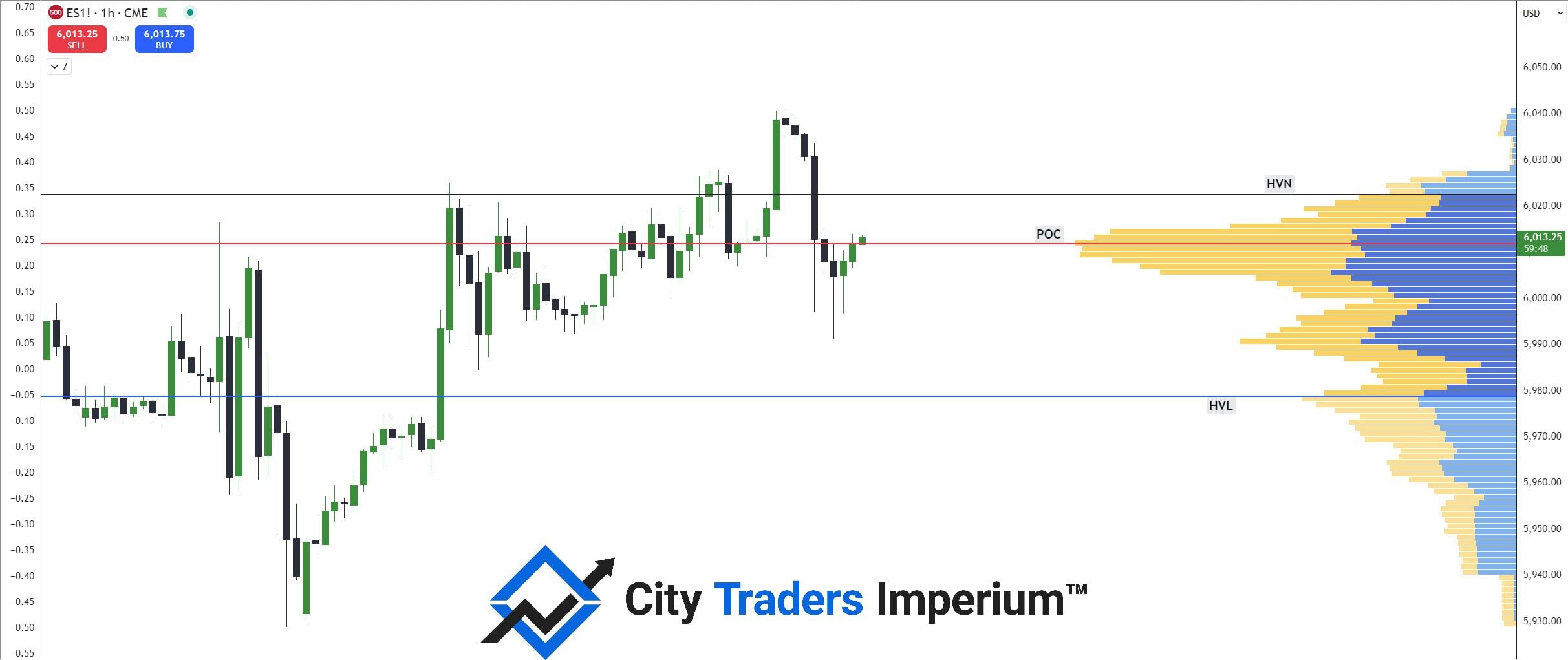
The red line marks the Point of Control (POC) — the price level with the most traded volume during a chosen timeframe.
The longest bars are High-Volume Nodes (HVNs) — areas of heavy activity where price moves slowly.
The shortest bars are Low-Volume Nodes (LVNs) — zones of low activity where price tends to move quickly.
Use volume profile to identify strong reaction zones and anticipate price behaviour.
Heat Maps
Heat maps visualise market liquidity by displaying the location of large resting orders on the order book. They use colour intensity (often red, orange, yellow) to indicate the concentration of buy or sell limit orders at each price level.
As price approaches these zones, traders watch to see if liquidity gets pulled (faked) or absorbed (real).
This helps anticipate reversals, breakouts, or liquidity sweeps. Heat maps are typically available on platforms like Bookmap, Quantower, or Sierra Chart.
Use them to track evolving sentiment and identify hidden barriers in real-time.https://www.youtube.com/watch?v=GvJzspRHqCU
Commitment of Traders (COT) Report
The COT Report, published weekly by the CFTC, shows how commercial and non-commercial traders are positioned in U.S. futures markets. It breaks down net long versus net short exposure across asset classes, including currencies, commodities, and indices.
In order flow trading, the COT offers a macro bias, helping confirm whether institutions are building or exiting positions. While not real-time, it’s a useful tool for swing traders, combining order flow with longer-term sentiment.
We’ll talk more about COT in a minute.
💡 Pro Trader Tip: Don’t get overwhelmed — master one order flow tool at a time. Focus on reading the DOM or footprint charts for one market until it clicks. |
Footprint Charts Deep Dive
While regular candlesticks only show price movement, footprint charts expose the battle between buyers and sellers inside each candle. They display executed volume at each price level, split between aggressive buys (market orders lifting the ask) and aggressive sells (hitting the bid).
Most platforms show:
- Green = aggressive buy volume
- Red = aggressive sell volume
- Bold/boxed level = Point of Control (PoC) – the price with the most volume traded in that candle
Anatomy of a Sample Candle
Let’s break down a bullish footprint candle:
52.25: 150 buys | 45 sells → +105 delta
52.20: 89 buys | 210 sells → −121 delta
52.15: 220 buys | 67 sells → +153 delta
Delta = Buy volume − Sell volume. A positive delta shows buyer aggression; a negative delta suggests seller dominance.
What Order Flow Candles Tells You
Strong Bullish Signal: Price rises with positive delta
Weak Rally: Price rises but delta turns negative (selling into strength)
Distribution: Heavy volume near highs + negative delta
Accumulation: Heavy volume near lows + positive delta
Key Patterns to Watch in Order Flow Data
Delta Divergence: Price makes a new high, but delta weakens — potential reversal
Absorption: Opposing pressure at high volume levels (e.g., 800 buys vs 500 sells = buyer absorption)
Volume Climax: A volume spike followed by a Delta reversal often signals exhaustion
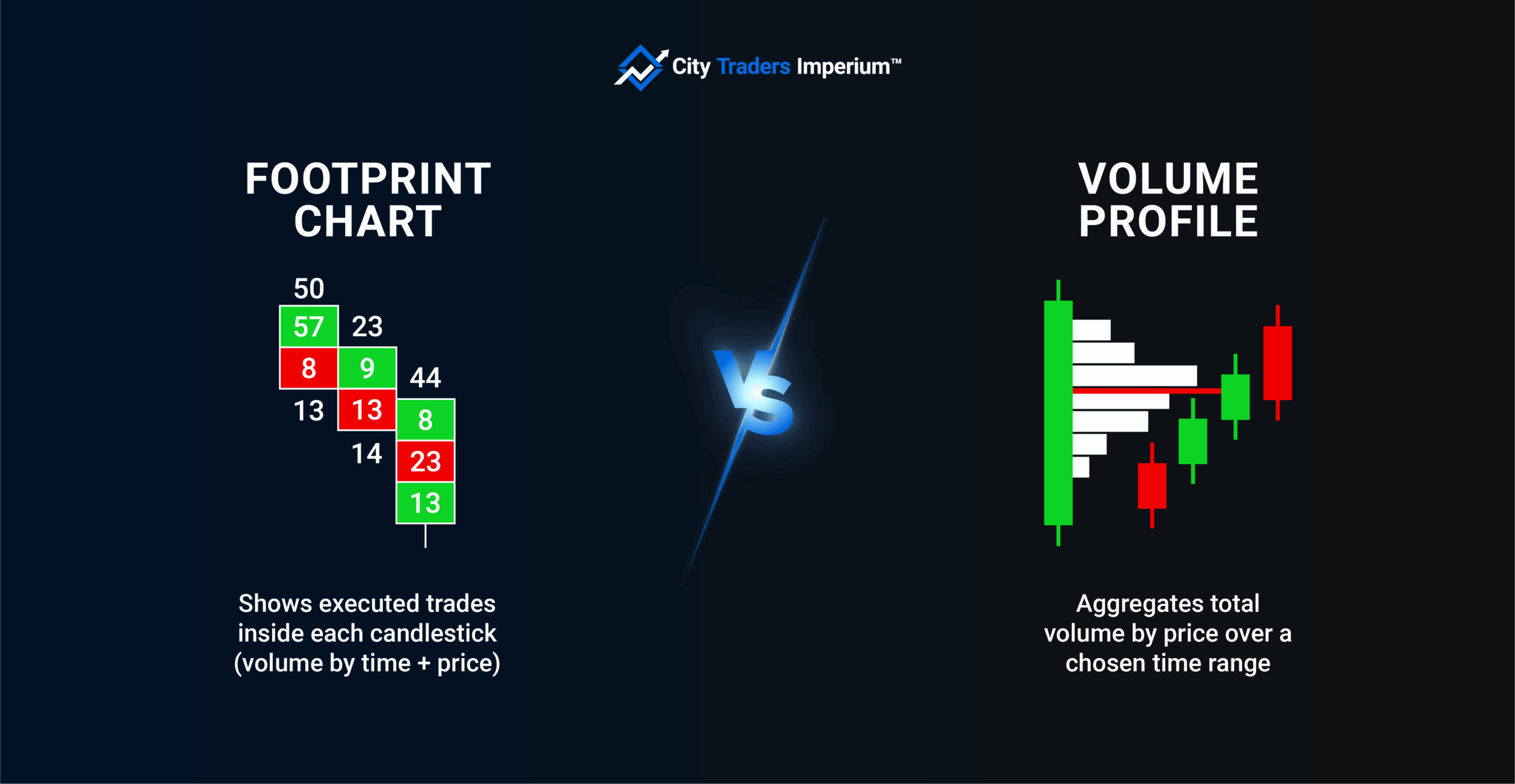
Footprint vs. Volume Profile
See the Footprint vs. Volume Profile graphic above for a quick comparison.
Use the volume profile for broader market context, and the footprint for precision execution inside key zones.
COT Report for Macro Flow
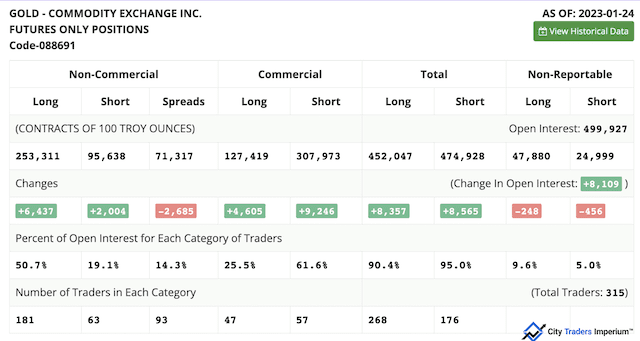
The already mentioned Commitment of Traders (COT) report provides institutional-level positioning data that reveals macro order flow trends.
Published weekly by the CFTC, this report breaks down futures market positions by trader categories, giving you insight into where the smart money is positioned.
Below is an image of the COT report on gold.
Quick Guide to Pulling Weekly COT Data
Step 1: Access the Data:
Visit the CFTC COT portal every Friday after 3:30 PM Eastern Time when new reports are released.
Step 2: Choose Your Report Type
Legacy Reports: Basic commercial vs. non-commercial breakdown (easiest for beginners)
Disaggregated Reports: More detailed categories, including managed money and swap dealers
Traders in Financial Futures (TFF): Best for currency and bond futures.
Step 3: Select Your Market:
Focus on liquid markets, such as ES (S&P 500), GC (Gold), CL (Crude Oil), or major currency futures, where positioning shifts matter most.
Step 4: Analyze Key Metrics
Net Positions: Long positions minus short positions for each trader category
Position Changes: Week-over-week shifts that signal momentum.
Reading COT for Order Flow Signals
Contrarian Setup: When non-commercial traders (large speculators) reach extreme net-long positions while commercials are heavily short, consider counter-trend trades.
Trend Confirmation: Rising non-commercial longs and declining commercial shorts often confirm the continuation of an uptrend.
Reversal Warning: Sudden shifts in managed money positioning frequently precede major trend changes.
The CFTC data represents 70-90% of total market open interest, making it a reliable gauge of institutional sentiment that complements your real-time order book analysis.
💡 Pro Trader Tip: Set up weekly email alerts through the CFTC subscription service to automatically receive COT reports. Track 3-4 key markets consistently rather than jumping between dozens. |
Popular Order-Flow Strategies
Okay, you know the basics of flow trading analysis and what tools you can use to trade it.
Now, let’s go through the most popular order flow trading strategies:
Establishing a Bias Using The Order Book
This approach is best suited for scalpers due to the rapid change in the number of orders. The order book next to the chart below is from the OKX exchange on XRP/USDT.
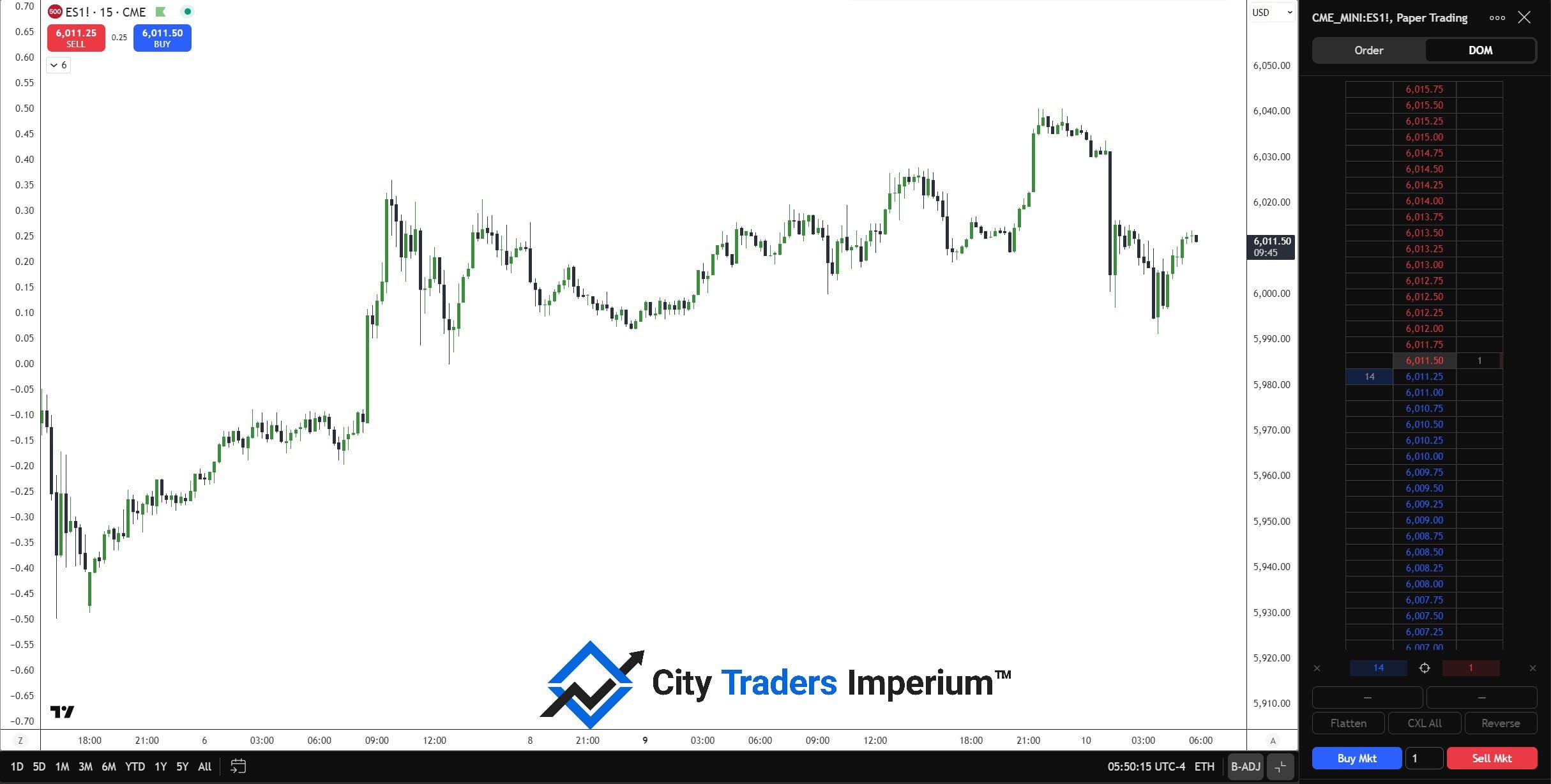
Firstly, you can see that the number of buy limit orders (at the bottom right of the chart) is higher than the sell limit orders.
This would have been the first indication of a bullish bias. Therefore, short-term traders can place their limit around the current price while monitoring whether the buy orders increase or decrease above the sell orders.
Order Flow Traps – Stop Hunts
Bull and bear traps play a significant role in supply and demand, making them essential for Order Flow analysis. These are simply moments of failed breakouts at specific chart levels. The concept is that the big players lure unsuspecting traders into these areas, only for the price to move in the other direction.
It’s not only breakouts that are exploited. Bull and bear traps also revolve around ‘stop loss hunting.’ This is a trading strategy where the big players capitalise on a massive number of stop-loss orders to force traders out of their positions.
We provided an earlier example of institutions needing to place their trades in small increments. It isn’t necessary for the average person because our lot sizes are small. Therefore, there will always be liquidity when we buy and sell.
Yet, it’s different for traders executing lot sizes worth hundreds of thousands or millions of dollars. These entities will need help finding opposing orders to meet this volume. Hunting for stop losses is an effective method for solving this problem.
We should remember that a stop-loss order executes like a regular order.
Let’s assume you had a sell position, and the price went up to your stop. When this order is triggered, it converts to a market buy order for other traders who are buying at the price at which the stop loss is set. So, selling at a loss is an opportunity for other traders to buy at this price.
Example:
Let’s go back to our earlier example; you want to buy 50 lots at $1, but only 20 lots are being sold here.
To receive the best entry price, you’d have to wait until there are enough sellers to fulfil the 50 lots. Stop losses represent the best way to do this, and it is made easier by the fact that most traders place them at obvious levels.
What does this mean for order flow distribution?
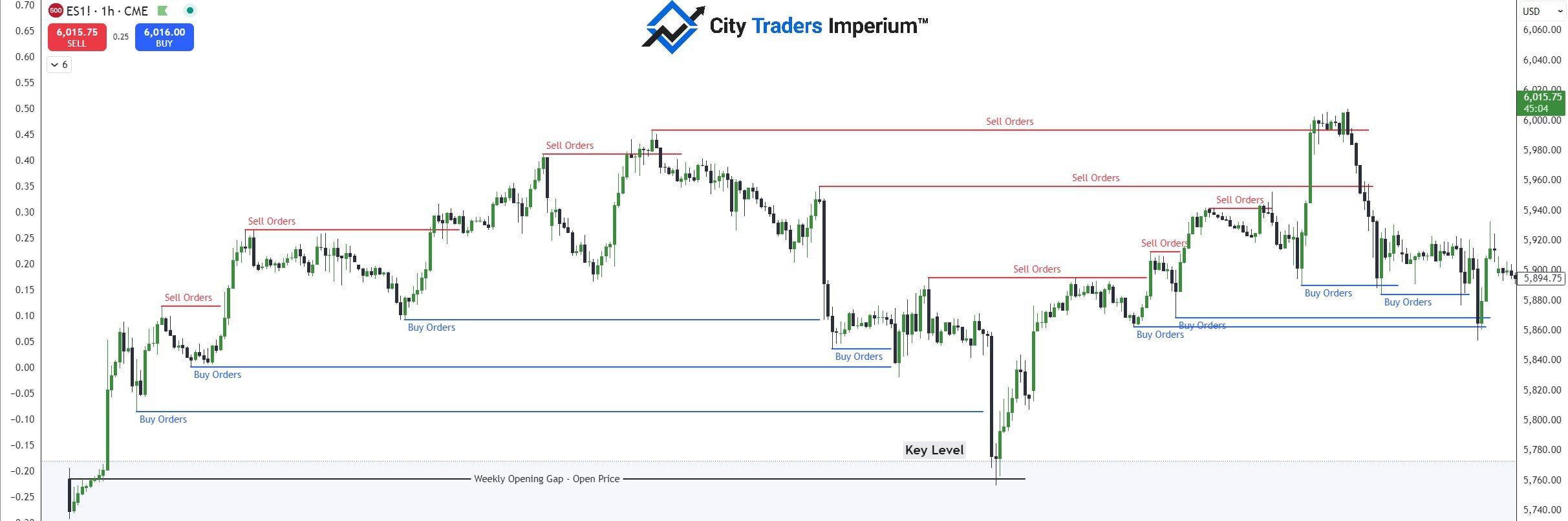
As mentioned earlier, the ‘big boys’ execute part of their massive orders above or below key highs and lows.
They will keep the positions open as the market returns to a level with clusters of stop-loss orders placed above or below key highs and lows.
These areas represent greater liquidity pools to fill up the rest of their initial order. Here, we expect the market to move at a greater depth than before.
You’ll see many moments where the price appears to bounce off the same area several times, which you can exploit regularly.
Liquidity Sweep Fade
A liquidity sweep fade is a classic stop-hunting move. Institutions push prices just beyond a major high or low, where stop orders are clustered, triggering a breakout trap. Then, the market quickly reverses as smart money fades the move and fills large limit orders at optimal prices.
You’ll often spot this using:
- Heat maps showing large orders just above key levels.
- A footprint chart showing aggressive delta flip after the sweep.
- A DOM showing sudden absorption post-breakout.
Watch for a wick or volume spike beyond structure, followed by reversal candles and a shift in delta.
💡 Pro Trader Tip: Time of Day Matters. Many false breakouts and sweep traps occur during periods of low liquidity, such as lunch hours or pre-market. Prioritise strategy execution during high-volume sessions for cleaner signals. |
Delta Divergence Breakout
A Delta Divergence Breakout occurs when the price moves through a key level, but the delta doesn’t support the move. This suggests the breakout is weak or false.
For a valid breakout, you want:
- Strong positive delta as price clears resistance.
- Volume is building up across levels, not just a single burst.
- Little to no opposing absorption on the footprint chart.
If Delta flattens or turns negative while price rises, it signals potential exhaustion — a great time to fade the move or wait for confirmation.
Order-Flow in Forex & CFDs
Order flow trading is built on transparency — being able to see real-time buying and selling pressure through tools like the Depth of Market (DOM) and footprint charts. But in forex and CFD markets, true order flow visibility is limited.
Unlike futures or stocks, forex is decentralised. There’s no central exchange, which means no unified order book. Instead, what you see is:
- Aggregated quotes from a few liquidity providers.
- Your broker’s internal client flow.
- Synthetic volume based on tick activity — not actual transactions.
Similarly, CFDs reflect the price movements of underlying assets, but your trades never directly affect the real market. Broker-side order books may show sentiment, but not institutional positioning.
⚠️ Caveat: When trading forex or CFDs, you’re seeing a small slice of a much larger market.
How to Adapt Order Flow to Forex
You can still apply order flow principles — just with the right tools and expectations:
Use COT reports to track institutional positioning on currency futures.
Study volume profiles on centralised assets (e.g., CME FX futures) to guide your forex bias
Correlate with related markets like bonds, equities, and macro indicators.
Treat broker-side order books as sentiment tools, not institutional flow.
💡 Pro Trader Tip: If your strategy relies on precise order flow data, consider learning about currency futures (such as 6E for EUR/USD), where tools for true volume, delta, and footprint are available. |
Back-Test Snapshot & Limitations
While order flow offers real-time market insight, a landmark Berkeley Haas study — “The Market Impact of Large Trading Orders” — reveals why it has limits.
Key findings indicate that market impact scales with the square root of order size, rather than linearly, meaning that larger orders have a disproportionate effect on price. Order flow is highly autocorrelated, often lasting over 1,000 trades, and market makers respond with asymmetric pricing to dampen predictable impact.
However, meaningful analysis requires massive datasets, and algorithms that detect hidden orders are prone to error, especially with large trades. The paper also confirms that price inefficiencies often reflect informed trading, not arbitrage.
Lastly, order size follows a power law distribution, meaning large, disruptive trades are more common than expected under normal models.
Common Mistakes Reading Order Flow
Even experienced traders can get tripped up by misreading order flow data or using it in the wrong context. Here are five deeper mistakes that can sabotage your edge:
Chasing Spoof Liquidity
Not every large order in the DOM is genuine. High-frequency traders often place “spoof” orders to fake support or resistance, then cancel before execution.
Don’t trade based on size alone — look for real fills, aggressive volume, and supporting delta shifts.
Trading Through Major News Events
Order flow tools often lose reliability during macroeconomic announcements (e.g., NFP, CPI, interest rate decisions). Spreads widen, slippage increases, and spoofing becomes rampant. Instead of reacting emotionally, wait for the post-news structure to form before acting.
Over-analyzing Dead Zones
DOM, heatmaps, and footprints offer the cleanest signals when liquidity is thick, like at session opens, overlap hours, or just before market close. Trading during midday chop often leads to false reads and mental fatigue. Time your strategy, not just your setups.
Blindly Trusting Delta
Delta alone doesn’t tell the full story. A positive delta in a declining market may indicate trapped buyers, rather than bullish strength. Always interpret delta in context — check for absorption, trapped volume, or divergence between price and flow.
Switching Tools Mid-Trade
Jumping between platforms or views mid-trade leads to second-guessing.
Commit to a plan: if your entry is based on footprint imbalance, don’t panic and flip to the DOM when things heat up. Consistency beats panic every time.
💡 ProTrader Tip: Record your screen during order flow trades and review them later for reference. Patterns that seem obvious in hindsight often reveal mistakes you missed in real-time. |
Order Flow FAQs
What is order flow trading?
Answer: Studying live buy/sell orders and executed volume to predict short-term price movements using order book data and transaction flow.
Which markets offer true order-book data?
Answer: Centralised exchanges like CME futures, NASDAQ stocks, and major crypto platforms. Spot FX lacks unified books since brokers only show internal flows.
What tools do I need for order-flow analysis?
Answer: Trading platforms with DOM/Level 2 support and footprint charts (Bookmap, Sierra Chart, NinjaTrader, TradingView Premium) plus exchange data feeds.
How do footprint charts differ from a volume profile?
Answer: Footprints show buy vs sell volume within each candle, while volume profiles display total volume distribution across price levels over time.
Is order-flow trading suitable for beginners?
Answer: It has a steep learning curve and extra data costs; practice on demo accounts, focus on one market, and use solid risk management.
Conclusion
Mastering order flow takes time, but the edge is undeniable – seeing actual buying and selling pressure beats lagging indicators every time. The learning curve is steep, but the insights into institutional behaviour are worth the effort.