

Introduction
The foreign exchange market, commonly known as Forex or FX, is the world’s largest and most liquid financial market. With a daily trading volume exceeding $6 trillion, it dwarfs all other financial markets combined. At the heart of this vast, decentralised marketplace lies a simple yet powerful concept: currency pairs.
Key Findings
- Major pairs—including EUR/USD, USD/JPY and five others—dominate a $6 trn-a-day market, giving traders the tightest spreads and fastest fills.
- Crosses such as EUR/GBP or GBP/JPY drop the dollar, track regional economics instead, and offer portfolio diversification at the cost of slightly wider spreads.
- Exotic pairs (e.g., USD/TRY, USD/ZAR) reward volatility hunters with large intraday swings, but thin liquidity and broad spreads demand smaller position sizing and strict risk control.
- Liquidity and momentum spike when trading sessions overlap—especially London–New York—so time entries around the session that most influences your chosen pair.
- Let strategy dictate pair selection: scalpers thrive on high-octane majors at session opens, while swing traders lean on steadier trends in majors or liquid crosses; reserve exotics for calculated, small-size plays.
What Are Forex Currency Pairs?
At its core, a forex currency pair is a quotation of the relative value of one currency unit against another currency unit. In other words, it’s the rate at which one currency can be exchanged for another. This concept is fundamental to forex trading because currencies are always traded in pairs.
The Structure of a Currency Pair
A currency pair consists of two elements:
- Base Currency: This is the first currency listed in the pair and is always equal to one unit.
- Quote Currency: This is the second currency listed and represents how much of this currency is needed to buy one unit of the base currency.
For example, in the EUR/USD pair, EUR is the base currency, and USD is the quote currency. If the EUR/USD exchange rate is 1.2000, it means 1 euro can be exchanged for 1.20 U.S. dollars.
Reading Currency Pair Quotes
Forex quotes typically include two prices:
- Bid Price: The price at which you can sell the base currency.
- Ask Price: The price at which you can buy the base currency.
The difference between the bid and ask price is called the spread, which is essentially the cost of trading.
Why Currencies Are Traded in Pairs
Currencies are traded in pairs for several reasons:
- Relative Valuation: The value of a currency is always relative to another currency. There’s no absolute value for a single currency.
- Simultaneous Buying and Selling: When you trade a currency pair, you simultaneously buy one currency and sell another.
- Exchange Rate Fluctuations: The constant fluctuation in exchange rates between currencies creates trading opportunities.
- Global Economic Interplay: Currency pairs reflect the economic relationships between countries and regions.
Major Currency Pairs
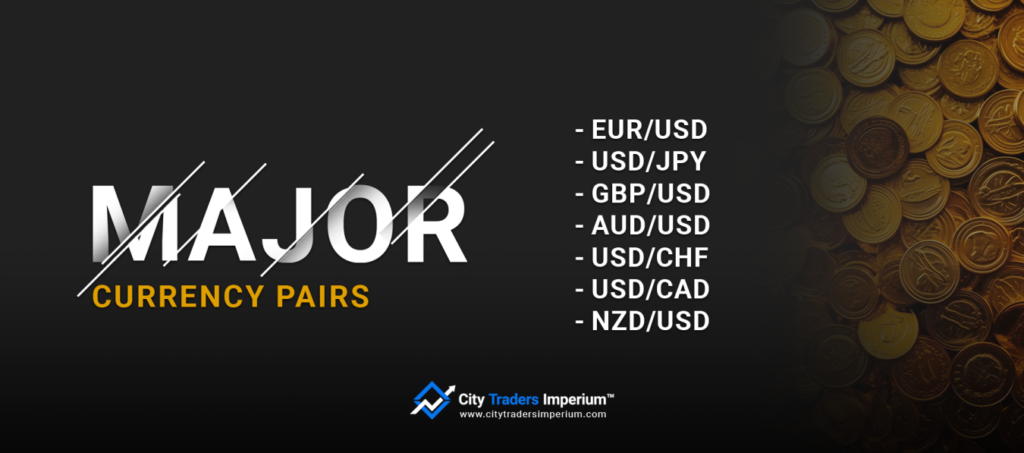
Major currency pairs are the most actively traded in the forex market, offering high liquidity, tight spreads, and stability. These pairs always include the US dollar (USD), reflecting its central role in global finance. The seven major currency pairs are:
- EUR/USD (Euro/US Dollar): Often called “the euro,” this is the most traded currency pair in the world. It’s known for high liquidity and tight spreads. The pair is heavily influenced by economic data from the Eurozone and the United States, as well as the policies of the European Central Bank (ECB) and the Federal Reserve.
- USD/JPY (US Dollar/Japanese Yen):Nicknamed “the gopher,” this pair is known for its stability and is often considered a safe-haven currency. It’s particularly sensitive to the interest rate differential between the US and Japan. Trade flows and the overall health of Asian economies can also influence the pair.
- GBP/USD (British Pound/US Dollar):Commonly referred to as “cable,” this pair is known for its volatility. It’s heavily influenced by economic data from the UK and US and political events, particularly those related to Brexit in recent years. The Bank of England’s monetary policy decisions also play a crucial role.
- AUD/USD (Australian Dollar/US Dollar):Often called “the Aussie,” this pair is sensitive to commodity prices, particularly gold and copper, due to Australia’s significant mining industry. It’s also influenced by the interest rate differential between the Reserve Bank of Australia and the US Federal Reserve.
- USD/CHF (US Dollar/Swiss Franc):Nicknamed “the Swissie,” this pair is known for its stability, as the Swiss Franc is considered a safe-haven currency. Due to Switzerland’s close economic ties with the Eurozone, it often moves inversely to EUR/USD.
- USD/CAD (US Dollar/Canadian Dollar):Known as “the loonie,” oil prices heavily influence this pair due to Canada’s significant oil exports. It’s also affected by the economic relationship between Canada and the US, as they are major trading partners.
- NZD/USD (New Zealand Dollar/US Dollar):Called “the kiwi,” this pair is influenced by agricultural commodity prices, particularly dairy, as New Zealand is a major dairy exporter. Like the AUD/USD, it’s sensitive to economic developments in China, a major trading partner for New Zealand.
Each major pair has distinct characteristics and behaves differently based on global economic events, interest rates, and market sentiment. Here’s why these pairs are popular among traders:
- High Liquidity: Major pairs have significant trading volumes, ensuring that orders are executed quickly and with minimal slippage.
- Low Spreads: Because of their high liquidity, major pairs typically have narrower spreads, reducing trading costs.
- Stability: Major pairs tend to be more stable than minor and exotic pairs, making them suitable for beginners.
When trading major pairs, consider the following strategies:
- Trend Following: This strategy involves identifying the prevailing trend and trading in its direction. Major pairs often exhibit long-term trends, providing opportunities for this approach.
- Breakout Trading: This strategy focuses on trading when the price breaks through key support or resistance levels. Major pairs are well-suited for this due to their liquidity.
- Range Trading: Some major pairs tend to trade within a defined range. This strategy involves buying at support levels and selling at resistance levels.
- Low Spreads: Due to its popularity and liquidity, the EUR/USD pair generally has the lowest spreads among forex pairs, reducing trading costs.
- Extensive Analysis: Given its prominence, there’s a wealth of information, analysis, and news available on the EUR/USD pair, aiding traders in making informed decisions.
Because of these factors, the EUR/USD pair is often the go-to choice for beginners and experienced traders alike. As the most traded currency pair it offers a stable and accessible entry point into the forex market while providing ample opportunities for profit through various trading strategies.
Minor Currency Pairs
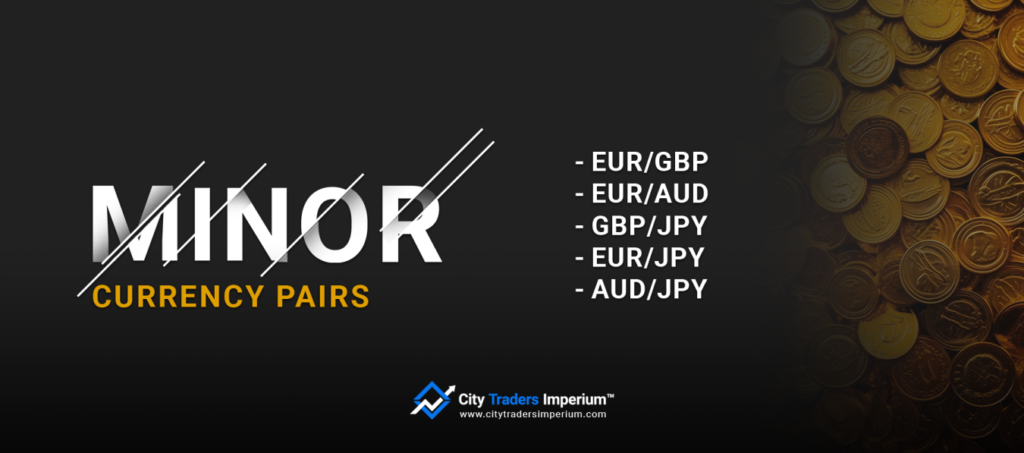
Minor currency pairs, also known as cross-currency pairs or crosses, do not include the US dollar. They involve major currencies other than the USD, offering traders additional diversification opportunities. Common minor currency pairs are:
- EUR/GBP (Euro/British Pound)
- EUR/AUD (Euro/Australian Dollar)
- GBP/JPY (British Pound/Japanese Yen)
- EUR/JPY (Euro/Japanese Yen)
- AUD/JPY (Australian Dollar/Japanese Yen)
Although minor pairs have lower trading volumes than major pairs, they can still offer excellent trading opportunities. The spreads are wider, but they are generally less correlated with major pairs, providing unique price movements. Here are some key points to consider about minor pairs:
- Diversification: Minor pairs allow traders to diversify their portfolios, reducing reliance on major pairs.
- Moderate Liquidity: While minor pairs have less liquidity than major pairs, they are still actively traded, providing sufficient opportunities for trading.
- Opportunities for Range Trading: Minor pairs often exhibit more stable trading ranges, making them suitable for range-based strategies.
Exotic Currency Pairs
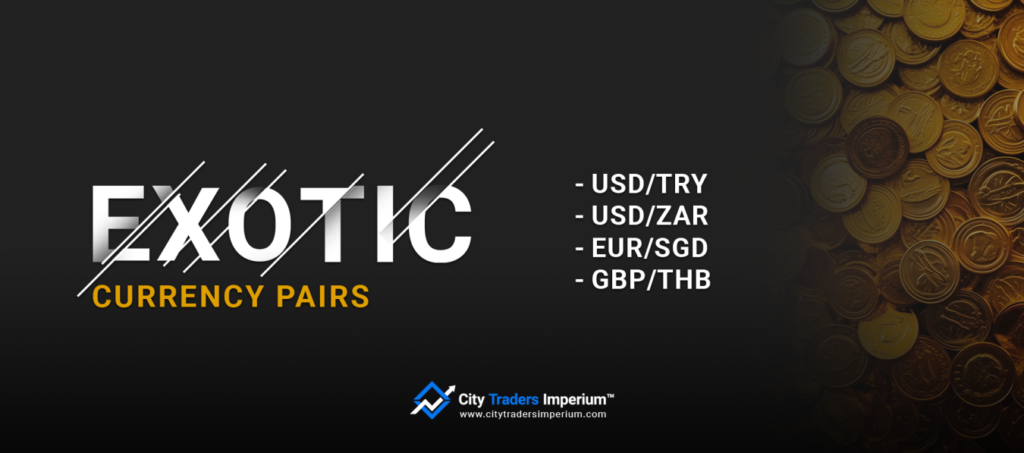
Exotic currency pairs consist of a major currency and a currency from an emerging market or less frequently traded economy. These pairs are known for their higher volatility, wider spreads, and lower liquidity compared to major and minor pairs. Common exotic pairs include:
- USD/TRY (US Dollar/Turkish Lira)
- USD/ZAR (US Dollar/South African Rand)
- EUR/SGD (Euro/Singapore Dollar)
- GBP/THB (British Pound/Thai Baht)
Exotic pairs can offer significant profit potential due to their high volatility, but they also come with increased risks. Here’s why traders might consider trading exotic pairs:
- Higher Volatility: Exotic pairs can experience significant price swings, offering traders the chance for large gains. However, this also increases the risk of losses.
- Unique Opportunities: Exotic pairs are influenced by political and economic events in emerging markets, providing unique trading opportunities not found in major and minor pairs.
- Higher Spreads: Because of lower liquidity, exotic pairs generally have wider spreads, increasing trading costs.
When trading exotic pairs, it’s essential to have a strong risk management strategy. Consider using stop-loss orders, smaller position sizes, and a disciplined approach to limit potential losses.
Choosing the Best Forex Currency Pairs
Selecting the best forex currency pairs to trade depends on your trading style, risk tolerance, and experience level. Here are some tips to help you make the right choice:
Start with Major Pairs
Major pairs are the best starting point if you’re new to forex trading. They offer several advantages:
- Stability: Major pairs tend to be less volatile than minor or exotic pairs.
- Low Spreads: Major pairs often have tighter spreads due to high liquidity, reducing trading costs.
- Abundant Information: There’s a wealth of analysis, news, and data available for major pairs,
Consider Your Trading Style
Your preferred trading style should influence your choice of currency pairs:
- Short-Term Traders: If you prefer day trading or scalping, you might favour more volatile pairs that offer frequent price movements. Some exotic pairs or even certain major pairs during news events can be suitable.
- Long-Term Traders: Major or stable minor pairs are more appropriate for position or swing trading as they follow longer-term trends.
Explore Minor Pairs for Diversification
Once you’re comfortable with major pairs, consider expanding to minor pairs:
- Minor pairs can offer unique trading opportunities, often influenced by region-specific factors.
- They can help diversify your portfolio, potentially reducing overall risk.
It’s also worth considering commodity currencies, such as the Australian Dollar (AUD), Canadian Dollar (CAD), and New Zealand Dollar (NZD). These currencies are closely tied to commodity prices and can offer unique trading opportunities based on movements in commodity markets. For instance, the AUD is often influenced by gold and iron ore prices, while the CAD is closely linked to oil prices.
Consider Trading Session Times
The forex market operates 24 hours a day, but it’s divided into major trading sessions. Different currency pairs may be more active during certain sessions:
- Asian Session (Tokyo):
- Active Pairs: USD/JPY, AUD/USD, NZD/USD
- European Session (London):
- Active Pairs: EUR/USD, GBP/USD, EUR/GBP
- North American Session (New York):
- Active Pairs: USD/CAD, USD/MXN, USD-based major pairs
When sessions overlap (e.g., London and New York), market activity often increases, potentially providing more trading opportunities.
💡Tips for trading based on sessions:
- Match your active trading hours with the most suitable pairs.
- Be aware of increased volatility during session overlaps.
- Pay attention to economic news releases, which often coincide with the opening of major sessions.
Conclusion
Forex trading requires a solid understanding of currency pairs, market dynamics, and trading strategies. From major pairs like EUR/USD and USD/JPY to minor and exotic pairs, each offers unique opportunities and challenges. When choosing which pairs to trade, consider factors such as liquidity, volatility, trading sessions, and global economic events.
Keep in mind that success comes from continuous learning, disciplined risk management, and adapting to ever-changing market conditions. Start with major pairs, gradually expand your portfolio as you gain experience, and always stay informed about global economic trends that can impact currency movements.
Practice with demo accounts before risking real capital. As you grow more confident in your abilities, you might consider seeking funding opportunities to scale up your trading.
City Traders Imperium’s challenge programs include one- and two-step evaluation processes designed to suit various trading styles and experience levels.
We provide competitive profit-sharing arrangements and multiple account sizes, giving you the opportunity to trade with significant capital without risking your own funds.
Ready to take your trading to new heights?