

Intro
In forex trading, understanding the concepts of bid and ask prices is essential for effective trading. These two prices form the basis of every currency quote and determine trading costs and potential profits.
Key Highlights
Here’s a quick overview of what you’ll gain from this article:
- Uncover the true nature of bid-ask spreads and their role in your trading decisions.
Learn how spreads reflect market conditions and how to use this information to your advantage.
- Discover strategies to handle widening spreads during market turbulence and high-impact events.
- Understand how different order types interact with bid-ask spreads to improve your trade entries and exits.
- Recognize why positions sometimes close unexpectedly and how to adjust your approach accordingly.
- Learn to interpret spread information across various trading platforms.
Bid Ask Spread Explained
The forex market operates on a two-price system: the bid price and the ask price. This system is fundamental to how trades are executed and how brokers make money.
The BID price is the price at which forex traders can sell a currency pair. It represents the highest price that a buyer in the market is willing to pay for that currency pair at a given moment.
The ASK price, on the other hand, is the price at which forex traders can buy a currency pair. It’s the lowest price that a seller in the market is willing to accept for that currency pair at that time.
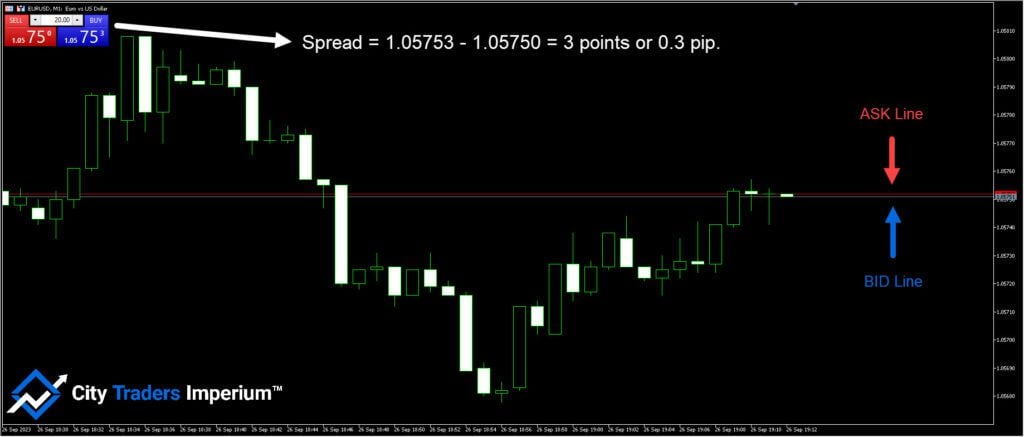
The difference between these two prices is known as the spread. The spread is essentially the gap between the buying and selling price of a currency pair, and it represents the cost of trading in the forex market.
Understanding the bid-ask spread is important for several reasons:
- It affects the cost of entering and exiting trades.
- It influences the calculation of potential profits or losses.
- It can vary based on market conditions, affecting trading strategies.
Traders need to consider the spread when planning their trading strategies and assessing the viability of potential trades.
A wider spread means a higher cost to trade, which can impact the profitability of short-term trading strategies in particular and is one of the reasons why forex traders lose money.
Conversely, a narrow bid ask spread can make certain trading strategies more viable, especially for high-frequency traders.
Buying at the Ask Price
As a forex trader, when you want to open a buy position (going long) on a currency pair, you will receive the “ask” price. This is the price at which you can enter the market to buy the base currency (the first currency in the pair) by using the quote currency (the second currency in the pair).
The ask price is typically slightly higher than the bid price due to the bid-ask spread.
For example, in EURUSD: EUR is the base currency and USD is the quote currency.
Selling at the Bid Price
Conversely, when you want to initiate a sell position (going short) on a currency pair, you will receive the bid price. This is the price at which you can enter the market to sell the base currency and receive the quote currency in return. The bid price is generally slightly lower than the ask price due to the bid-ask spread.
In essence, the bid and ask spread represents the cost of executing trades in the forex market. Traders need to take this spread into consideration when planning their trading strategies and calculating potential profits or losses.
Example of the BID-ASK Price Concept
Imagine you’re looking at the exchange rates for the EUR/USD currency pair in the forex market.
- The current bid price for EUR/USD is 1.1000.
- The current ask price for EUR/USD is 1.1005.
This means:
- When you’re looking to open a long position (buy position) on a currency pair like EUR/USD, your order will be executed at the ask price of 1.1005. This means you’re buying the base currency (EUR) and selling the quote currency (USD) at the ask price.
- On the other hand, if you’re aiming to open a short position (sell position) on the same EUR/USD currency pair, your order will be executed at the bid price of 1.1000. This involves selling the base currency (EUR) and receiving the quote currency (USD) at the bid price.
The spread in this scenario is the difference between the bid price and the ask price:
Spread = Ask Price – Bid Price
Spread = 1.1005 – 1.1000 = 0.0005 (or 5 pips).
In simpler terms, if you were to buy 1 Euro (EUR) at the ask price of 1.1005 and immediately sell it back at the bid price of 1.1000, you would incur a loss equal to 5 pips x pip value per lot due to the spread.
For example, if your lot size was 1 standard lot, then pip value per lot is $10 per lot, and your loss would have been 5 x $10 = $50 USD.
How Market and Pending Orders Get Executed?
There are 4 types of Market Orders:
For long (buy) positions:
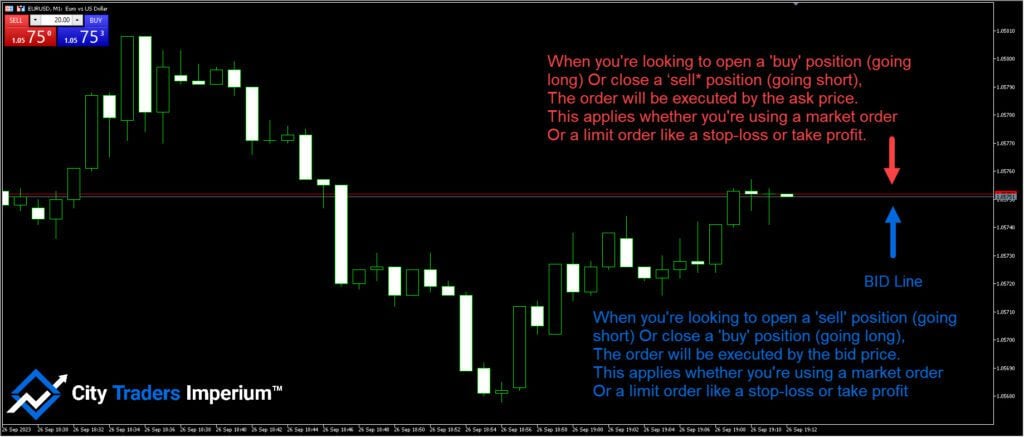
- Limit orders to buy will be executed at the ASK price.
- Stop-loss and take-profit orders for long positions will be executed at the BID price.
For short (sell) positions:
- Limit orders to sell will be executed at the BID price.
- Stop-loss and take-profit orders for short positions will be executed at the ASK price.
In both long and short positions, the execution of orders follows the principle that limit orders are executed at prices aligned with entering the market, while stop-loss and take-profit orders are executed at prices aligned with exiting the market.
The bid price is used for exiting long positions and entering short positions, while the ask price is used for exiting short positions and entering long positions.
Why My Position Gets Closed Even When Price Did Not Reach It?
The discrepancy between the default chart price (often displaying the bid price) and the execution price (which can be either bid or ask) can lead to confusion and misunderstanding among forex traders.
This is a critical aspect of trading that traders need to be aware of, as it affects how orders are executed and their potential outcomes.
The price that prints on the chart is always based on the Bid price; therefore, when a trader gets stopped while the price never reaches a certain level, it is because the trader was stopped due to the Ask price hitting stop loss.
This happens when a trade has a sell position open and gets stopped out due to the ask price hitting the stop loss.
This also happens when a trade misses a take profit level of a sell position. If the ask price does not reach the take profit level, then the trade will not be filled, and the trader will miss exiting at the take profit level.
We will expand on this in the next section, “The Importance of Understanding the Bid-Ask Price Difference.”
Market Rollover Time: Wider Bid and Ask Spreads
“Rollover” is the process of extending the settlement date of an open position when it reaches its value date. Essentially, if a trader decides not to close a position by the end of the trading day, that position is “rolled over” to the next trading day. Rollover typically happens at the end of the trading day at 5 PM EST.
During rollover time in the forex market, traders often observe a phenomenon where spreads tend to widen. Rollover is a time when the liquidity of the market can momentarily diminish. As banks and institutional traders reconcile and roll over their positions to the next trading day, the reduced supply liquidity and increased uncertainty can lead liquidity providers to adjust their spread offerings as a protective measure.
This widening of spreads acts as a buffer against potential market volatility and erratic price movements. Traders should exercise caution when placing or holding trades during this period to avoid unexpected slippage and costs.
Non-major pairs, which already have inherently lower liquidity than major pairs, can experience a significant drop in available buyers and sellers. This reduced liquidity can cause the bid and ask spread to widen as there are fewer active participants to take the other side of a trade.
The Spread Is the Cost of Doing Business
Consider this: a narrow bid and ask spread signifies a highly liquid market where there’s a high volume of trading activity. Conversely, a wide spread suggests lower liquidity and potentially higher trading costs.
For traders, this translates into a critical decision point. A tighter spread means a smaller cost of doing business, while a wider spread can eat into profits. Being aware of the spread ensures that traders can make informed decisions about when and how to execute their trades.
This is why, with CTI, we have one of the best spreads in the market, with an average spread of EURUSD of 0.1 pips or 1 point.
The Impact of Volatility on Spreads
Let’s discuss how market volatility can shake things up when it comes to spreads. Understanding this relationship helps traders make smart decisions and keep their risk in check.
When the Market Gets Wild
When the market’s having a rollercoaster dayhat happens to those spreads? Well, they tend to widen up. Here’s why:
- Market makers and liquidity providers aren’t taking any chances. They widen those spreads to protect themselves from rapid price swings.
- It’s like a domino effect—high volatility often means lower liquidity. Why? Some traders prefer to stay on the sidelines when things become too unpredictable.
- Fewer players in the market? You guessed it – even wider spreads.
How to Trade the Choppy Waters
So, how do you trade when the market’s in turmoil? Here are some pro tips:
- Ditch the market orders and opt for limit orders.
- Consider giving your stop-loss orders some breathing room. The market might need a bit more time to settle down.
- Brace yourself for some slippage, especially if you’re placing larger orders. It’s just part of the game in volatile times.
Volatility Indicators
Want to stay ahead of the curve? Here’s how:
- Keep an eye on indicators like the Average True Range (ATR) or Bollinger Bands. They’ll give you a heads-up on potential volatility.
- Tweak your strategy accordingly. It’s all about adapting to the market conditions.
Dealing With High-Impact News Fluctuations
In the realm of forex trading, noteworthy high-impact news events such as NFP, Interest Rates, CPI, important economic updates, sudden policy shifts, and increased geopolitical risks can send ripples through the market, causing the spreads to become wider.
Having a firm grasp of how bid and ask spreads behave during these critical events is key to executing trades with finesse and ensuring protection against potential risks.
Expanding Bid and Ask Spreads: A Warning Bell
As high-impact news releases, bid and ask spreads tend to widen, reflecting heightened market uncertainty and increased trading activity. This phenomenon can lead to slippage, where a trade is executed at a different price than expected.
This is because when the price moves tens or hundreds of pips within a fraction of a second, it would be impossible for orders to be filled at the exact price the order is placed as it takes a few seconds to be filled.
This phenomenon causes the price to be filled at the next best available price.
So, for traders, this means being vigilant during these events. Consider placing limit orders to control the maximum price you’re willing to pay or the minimum price you’re willing to accept.
The Importance of Understanding the Bid and Ask Difference
Chart Display:
Many popular trading platforms, including MT4 and MT5, typically display price charts using the bid price. This is because the bid price is generally lower than the ask price, and it’s the price at which traders can sell a currency pair at any given moment.
In most of the trading platforms, we can also add the ask price as a visual line on the chart through the specific setting of each platform.
Order Execution:
When traders place orders, the execution price is based on whether it’s a buy order (long position) or a sell order (short position). Buy orders are executed at the ask price, while sell orders are executed at the bid price.
This can lead to a discrepancy between what traders see on their charts and the actual execution price of their orders. For example:
- If a trader sees the EUR/USD pair at 1.1000 on the chart (which is the bid price) and places a buy order with a limit price of 1.1005, the order might get executed at a slightly higher price due to the ask price being slightly higher than the bid price.
- Conversely, if a trader sees the same EUR/USD pair at 1.1000 on the chart and places a sell order with a limit price of 1.0995, the order might get executed at a slightly lower price due to the bid price being slightly lower than the ask price.
To mitigate this confusion, traders should be aware of the bid-ask spread and the potential for slight variations in execution prices. When placing orders, especially limit orders, traders should consider these differences and the potential impact on their trades.
Additionally, utilizing features like level 2 data (which provides more granular pricing information), adding the ask price to the charts, and understanding the dynamics of bid and ask prices can help traders make more informed decisions.
Understanding Spread Discrepancies In Trading Platforms

Figuring out the spread can be a bit confusing for traders, especially for beginners who are just starting out. The thing is, on some brokers’ platforms, they show the price with four numbers after the dot, while on others, it’s five.
That fourth number? That’s your pips.
And the fifth? Those are your points.
And just to keep it simple, 10 points make up 1 pip.
Certainly! Let’s use the provided bid and ask prices for Broker A and Broker B.
Broker A:
- Bid Price: 1.2500
- Ask Price: 1.2502
The spread is calculated as:
Spread = Ask Price – Bid Price = 1.2502 – 1.2500 = 0.0002
So, on Broker A’s platform, the spread is 0.0002, which is equivalent to 2 pips.
Broker B:
- Bid Price: 1.25000
- Ask Price: 1.25013
The spread is calculated as:
Spread = Ask Price – Bid Price = 1.25013 – 1.25000 = 0.00013
On Broker B’s platform, the spread is 0.00013, which is equivalent to 1.3 pips (since 10 points make up 1 pip).
This example demonstrates how the spread is determined using the provided bid and ask prices on Broker A and Broker B’s platforms.
Conclusion
As we’ve explored, the bid-ask spread is more than just a pair of numbers on your trading screen—it’s a vital component of the forex market’s ecosystem.
The bid-ask spread serves as a barometer for market liquidity, a gauge for potential trading costs, and a signal for market sentiment.
Remember, the forex market is dynamic, and spreads can change rapidly. Staying alert to these changes—whether they result from regular market cycles, economic announcements, or unforeseen global events—is needed to maintain a competitive edge.
Make it a priority to regularly analyze bid-ask spreads across different currency pairs and market conditions. This practice will sharpen your market intuition and contribute to more refined trading strategies over time.
For traders looking to put their knowledge into practice, City Traders Imperium could be your next step. We offer a unique opportunity by funding skilled traders through our challenge programs. These programs allow you to demonstrate your trading abilities, including your understanding of concepts like bid-ask spreads, in a real market environment and potentially access significant trading capital.