


Intro
Have you ever watched a spring coil tighter and tighter, knowing it’s about to pop? That’s what price compression feels like in the forex market. It’s those moments when prices seem stuck, barely moving, but tension is building beneath the surface. Seasoned traders keep a keen eye out for these periods because they often signal a big move is coming.
This article will walk you through what price compression really means, why it matters for your trades, and how you can use it to potentially anticipate where the market is heading next.
Key Findings
- Price compression shows a fragile balance of buyers and sellers and often foreshadows a sharp breakout, alerting traders to coming volatility.
- Overlaying compression zones on supply or demand levels sharpens entries—sell at supply, buy at demand—for quick, high-probability moves.
- When stuck in a compressed range mid-trade, stick to your thesis, keep stops and targets in place, and stay ready for an explosive snap.
- Common mistakes include jumping in before a confirmed breakout, ignoring the broader context, overtrading, and abandoning risk rules.
- Compression reading works best when paired with other tools, such as support-resistance and a flexible, adaptive mindset.
What Is Price Compression?
Recognizing price compression is crucial for traders because it offers valuable insights into potential market shifts. When prices are compressed, it suggests that the market is in a state of equilibrium, with buying and selling pressures roughly balanced.
This situation often comes right before a spike in market activity, which can lead to some solid trading opportunities if you’re prepared. When we trade against compression, we often find ourselves on the stronger side of the market. It’s not a guarantee, but it can definitely tilt the odds in our favor.
Now, let’s explore the strategy of combining price compression with Supply and Demand levels:
Supply and Demand Levels:
- These are key levels on a price chart where there is a significant concentration of buying or selling interest. Supply levels act as barriers to upward price movement, while Demand levels act as barriers to downward price movement.
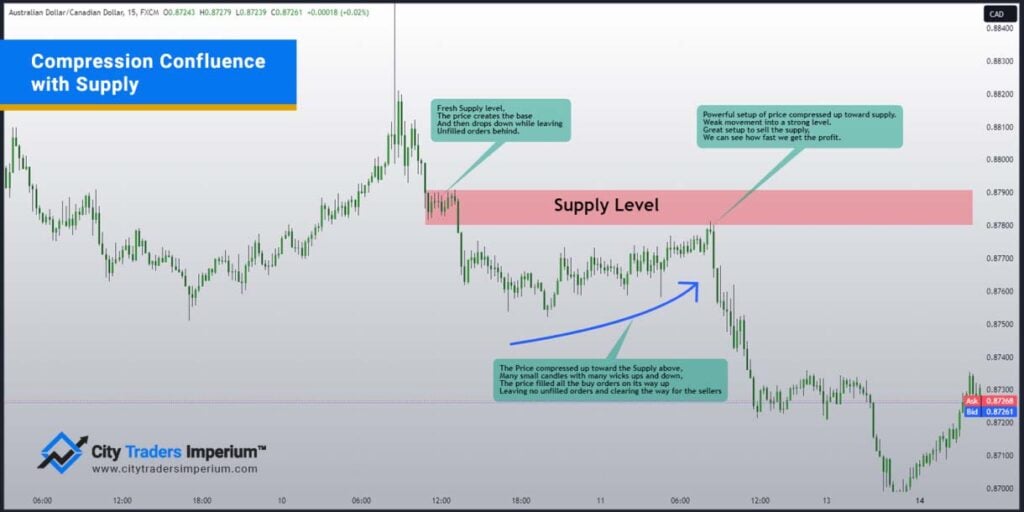
Selling at Supply Level with Price Compression:
- When price compression occurs and it aligns with a Supply level, it signifies a convergence of technical factors. This is powerful because it indicates that the market is testing a strong level with limited upward momentum. Traders interpret this as a favorable opportunity to initiate a short position.
Reasons for Selling at Supply Level:
- High Probability of Success: Since price is struggling to move beyond the Supply level due to the compression, there’s a higher likelihood of a successful trade.
- Swift and Secure Profits: As there are no lingering unfilled orders (if we’re selling against compression), once the price starts moving in the expected direction, it tends to reach the profit target quickly and without significant obstacles.
Psychological Benefits:
- The swifter movements typically seen after a period of compression assist us in reaching our targets more securely and expeditiously. This aids traders in overcoming a prevalent psychological hurdle: the tendency to prematurely close a winning position due to the fear of losing a profitable trade.
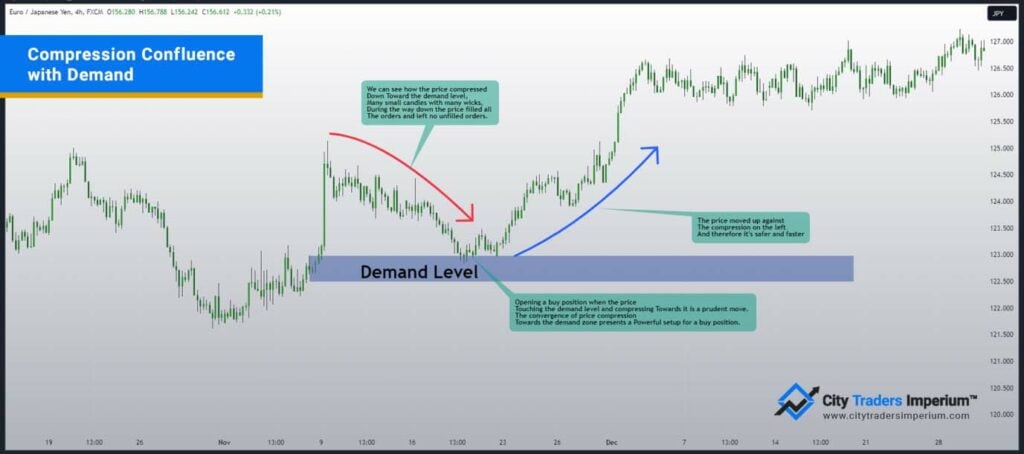
Buying at Demand Level with Price Compression:
- Conversely, when price compression aligns with a Demand level, it indicates a strong support zone. This presents an attractive opportunity to initiate a long position.
By integrating trading compression with Supply and Demand levels, traders gain a comprehensive understanding of market dynamics. This strategy not only provides entry and exit points but also offers a framework for managing trades effectively. It’s a potent tool for making informed and confident trading decisions in the forex market.
What if you find yourself inside price compression while holding an open position?
Finding yourself inside price compression while holding an open position can be a challenging situation for a trader. It essentially means that the market has entered a phase of reduced volatility and uncertainty, potentially leading to a breakout in either direction. Here are some considerations and potential strategies to navigate this scenario:
Stay Calm and Monitor Closely:
- First and foremost, it’s crucial to remain composed. Price compression often precedes a significant price movement, so it’s important not to make impulsive decisions.
Review the Initial Trade Thesis:
- Revisit the reasons why you entered the trade in the first place. Assess whether the factors that led you to open the position are still valid. This could include technical indicators, fundamental analysis, or any other relevant information.
Set Clear Stop-Loss and Take-Profit Levels:
- Having predefined stop-loss and take-profit levels is essential in any trade, but especially so in situations of price compression. These levels act as safeguards against unexpected price movements.
Consider Trailing Stop-Loss:
- If the price has moved in your favor and you’re in profit, consider using a trailing stop-loss. This allows you to lock in profits as the price moves in your direction, while still giving room for potential further gains.
Be Prepared for Potential Volatility:
- Understand that once the price compression phase ends, there may be a sudden surge in volatility. This can lead to a rapid breakout, either in your favor or against you.
Evaluate News and Events:
- Keep an eye on any upcoming economic events, news releases, or announcements that may impact the market. Unexpected news can be a catalyst for a breakout.
Consider Partial Position Closure:
- If you’re uncomfortable with the uncertainty of price compression, you might consider closing a portion of your position to reduce exposure.
Reassess and Adjust Your Strategy:
- If the conditions in the market have changed significantly since you opened the position, it may be necessary to reevaluate your trading strategy and adjust your approach accordingly.
Have a Contingency Plan:
- Plan for different scenarios. What will you do if the price breaks out in your favor? What if it goes against you? Having a clear plan for various outcomes can help you react swiftly and confidently.

Mastering the Language of Trading: Price Compression Unveiled
Trading is like learning a language; the charts are where this language is written. If we don’t understand this language, it’s tough to make money. But once we do, trading becomes not just A Skill but also enjoyable. We can explain every move we make based solely on what the price Is doing, without relying on indicators or other tools. Understanding this language is our best shot at being profitable.
Price compression is only one aspect of this language. Once we understand price Compression and how to identify it, there are many ways to use its valuable insights. The image above demonstrates how we can use price compression, how to understand price Movement, and how to make trading decisions by looking at a naked chart with only the price shown on the chart.
Common Pitfalls in Price Compression Trading and How to Sidestep Them
Even the most seasoned traders can trip up when dealing with price compression. One of the biggest blunders is jumping the gun. You’ve been watching that compressed range for hours and itching to make a move. But hold your horses! Entering too early, before a clear breakout, can leave you caught in a false move.
Another trap traders often fall into is getting tunnel vision. You’re so focused on that tight little price range that you miss the forest for the trees. Remember, price compression doesn’t exist in a vacuum. It’s crucial to zoom out and consider the bigger market picture. Are you trading against a major trend? Is there a big economic announcement coming up? These factors can make or break your compression trade.
Now, here’s a pitfall that’s all too common: overtrading. Not every bout of price compression is your golden ticket to profit town. Sometimes, the market compresses and then… just keeps compressing.
Last but definitely not least, let’s talk about risk management. When you see that price finally breaking out of compression, it’s easy to get caught up in the excitement. Your heart’s racing, adrenaline’s pumping, and before you know it, you’ve risked way more than you should have. Remember, no matter how promising a breakout looks, the market can turn on a dime. Always stick to your risk management rules – they’re your safety net.
In Conclusion – Mastering Price Compression
Price compression is your window into the market’s next big move. By spotting these quiet moments before the storm, you’re setting yourself up to catch profitable waves when they break. But remember, it’s not about rigid rules. The market’s always changing, so stay flexible and blend compression analysis with your own trading style.
It works best when paired with other techniques, like support and resistance levels. The real magic happens when you put all this into practice.
Ready to apply these price compression strategies with real capital? City Traders Imperium offers funded trader programs that let you trade with our money while keeping most of the profits.