

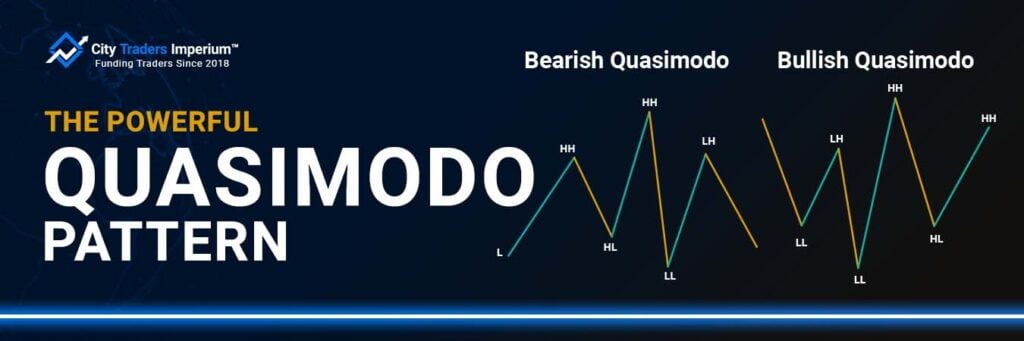
As you dive deeper into the world of technical analysis in forex trading, you might come across the Quasimodo pattern. Considered one of the most powerful and reliable forex chart patterns, the Quasimodo (or QM for short) reversal pattern can provide some valuable insights for your trading decisions.
In this article, we will explore this powerful pattern, how to identify it, what its advantages are, and how to use it in both bullish and bearish trends.
Key Findings
- The Quasimodo pattern signals impending trend reversal via a disrupted sequence of highs and lows, and it is applicable to both bullish and bearish markets.
- The Crooked Head-and-Shoulders shape features points A–E; traders enter at point E after retracing to the Quasimodo level and stop above/below the recent extreme.
- Combining Quasimodo with momentum indicators, Fibonacci levels, and higher-timeframe supply/demand zones boosts reliability and filters false signals.
- Pattern offers favorable risk-reward; early trend entry and tight stop placement yield substantial potential gains with limited exposure.
- Pitfalls include trading every pattern, entering prematurely, ignoring confirmation, and misaligning stop-loss size with volatility.
What Is the Quasimodo Pattern in Forex?
The Quasimodo pattern in forex is a reversal pattern signaling a potential trend change characterized by a specific sequence of highs and lows. When drawn, it looks like a crooked Head & Shoulders pattern you might be familiar with.
Its unique structure isn’t the only thing setting it apart, though. Unlike many of its counterparts, the Quasimodo pattern brings a much more solid and dependable vibe, offering an extraordinary risk-reward balance that sets it apart.
💡 Fun Fact: Although its origins aren’t certain, the pattern owes its name to the iconic Quasimodo, you know, the hunchbacked character from Victor Hugo’s famous story, “The Hunchback of Notre Dame.” And fair to say that it’s earned its name. The Quasimodo pattern captures price movements’ quirky asymmetry. This results in a pattern with a captivating lopsidedness to it, resembling Quasimodo’s iconic hunchback.
A Deeper Dive into the QM Pattern
As mentioned, the Quasimodo pattern resembles the well-known Head & Shoulders pattern but with a distinctive, crooked appearance.
Typically, trends are marked by a consistent sequence of ascending highs and lows in an uptrend or descending highs and lows in a downtrend. However, the Quasimodo pattern emerges when this rhythm is disrupted, creating an imbalance in the price structure.
This disruption signifies a potential shift in market momentum, making it a key signal for traders to anticipate reversals. Let’s explore how it works:
Illuminating Uptrend Dynamics
Consider an uptrend scenario within the foreign exchange market. Let’s say there’s a currency pair basking in a prolonged uptrend with higher highs and lower lows — testimony to unflinching bullish momentum. The confidence in the upward trajectory is high.
But, as we all know, the market is unpredictable. A sudden plummet in price materializes, defying the established pattern of higher lows.
This unanticipated descent, disrupting the rhythmic ascent, births the Quasimodo pattern within the very heart of the uptrend. This episode encapsulates the Quasimodo pattern’s role within an uptrend. The appearance of a lower low indicates a potential wane in the bullish trend.
For traders, this pattern serves as a signal to reassess trading strategies and adjust risk management plans accordingly.
Navigating Downtrend Complexities
Transitioning to a downtrend scenario in the forex market, imagine a currency pair locked in a steady decline, marked by lower highs and lower lows, reflecting strong bearish sentiment among traders and investors.
Suddenly, an unexpected surge of upward momentum breaks through the previous high, creating a higher high and disrupting the downward flow.
This shift signals a possible change in market direction and introduces the Quasimodo pattern, hinting at a potential reversal. This pattern challenges the prevailing bearish sentiment, prompting traders to adapt.
In this scenario, the Quasimodo pattern serves as a cue to reevaluate strategies, adjust stop-loss placements, and realign their overall trading approach to anticipate the changing market dynamics.
Quasimodo Pattern vs. Head & Shoulders Pattern
The Quasimodo and Head & Shoulders patterns have many things in common. Still, they aren’t the same, offering forex traders unique benefits. Here’s a quick look at how these two popular patterns compare:
| Quasimodo Pattern | Head & Shoulders Pattern |
|---|---|
| Shape is similar to a crooked Head & Shoulders with uneven highs/lows. | More symmetrical shape with a central “head” and two “shoulders.” |
| Found during trend reversals in both bullish and bearish markets. | Typically forms at the top of an uptrend or the bottom of a downtrend (Inverse Head & Shoulders). |
| Focuses on disruptions in consistent highs or lows to signal a reversal. | Relies on the neckline as the key confirmation level. |
| High reliability when combined with supply/demand levels or compression. | High reliability when the neckline is broken with strong momentum. |
| Suitable for traders seeking precision at key supply/demand levels. | Commonly used to identify broad trend reversal points. |
Leveraging the Quasimodo Levels
To harness the full potential of the Quasimodo pattern, you need a deep and nuanced grasp of Quasimodo levels. Let’s break down the anatomy of the forex QM pattern on both bullish and bearish scenarios:
Bearish Quasimodo Scenarios
The bearish Quasimodo pattern marks a key turning point in trading. Forming after an upward trend, it signals a potential reversal and an opportunity for a short (sell) position. The focus is on identifying crucial levels with precision.

- Point A spotlights the second-to-last highest point in the preceding uptrend.
- Point B represents the last low of the preceding uptrend, as we can see, this low is higher than its predecessor.
- Point C illustrates the most recent peak in the price during the preceding uptrend.
- Point D breaks the previous uptrend of higher lows with a sudden lower low, forming the Quasimodo pattern. Point C is the key level to watch for a short (sell) position. A faster, stronger move from C to D makes the pattern more reliable.
- Point E depicts the entry point for a short (sell) position. Following the price retracement from point D back to C, which designates the Quasimodo level, we aim to initiate a short (sell) position typically at the same level of the left shoulder, which is point A.
Bullish Quasimodo Picture
In the case of a bullish Quasimodo, the focus shifts to a potential bullish reversal:

- Point A spotlights the second-to-last lowest point in the preceding uptrend.
- Point B represents the last high of the preceding downtrend, as we can see, this high is higher than its predecessor.
- Point C illustrates the most recent low in the price during the preceding downtrend.
- Point D disrupts the downtrend of lower highs with a sudden higher high, forming the pattern. Point C is the key level to consider for a long (buy) position. A quicker, stronger move from C to D increases the pattern’s reliability.
- Point E depicts the entry point for a long (buy) position, following the price retracement from point D back to C, which designates the Quasimodo level, we aim to initiate a long (buy) position typically at the same level of the left shoulder which is point A.
Benefits of the Quasimodo Pattern
The Quasimodo pattern offers several unique advantages to forex traders. These include:
Great Risk-Reward Ratio:
Trading with the Quasimodo pattern offers a favorable risk-reward ratio. This means that the potential reward is substantially higher than the risk, providing traders with a solid foundation for making strategic decisions.
Early Entry Into New Trends:
Leveraging the Quasimodo level allows traders to position themselves at the inception of a new trend. This early entry can lead to more substantial gains as the trend develops, maximizing profit potential.
Low-Risk Exposure:
Trading forex with the Quasimodo pattern comes with well-defined risk parameters. Typically, the stop loss is set just a few pips above the last high in a bearish Quasimodo or a few pips below the last low in a bullish one. This controlled risk approach provides a safety net for traders.
Reliable and Powerful Pattern:
The Quasimodo pattern has gained a reputation for its reliability and potency. It boasts a high success rate, making it a favored choice among discerning traders, with its consistent performance adding a level of confidence to trading decisions.
How to Trade the Quasimodo Pattern in Forex?
So yes, the Quasimodo pattern is a powerful tool for identifying potential reversals in the forex market. However, to use it effectively, you must learn how to place limit orders strategically and manage risk. Here’s a step-by-step guide:
1. Identify the Quasimodo Pattern
The first step is recognizing the Quasimodo pattern on your chart. Look for a specific sequence of price movements that resembles the pattern:
- In a bullish pattern: A downtrend disrupted by a higher high, creating the potential for a reversal.
- In a bearish pattern: An uptrend interrupted by a lower low, signaling a shift in momentum.
Got it? Great. Now, just ensure the price forms the expected highs and lows, creating the distinctive “crooked” head-and-shoulders shape. If yes, then you have yourself a nice Quasimodo pattern.
2. Locate Key Supply and Demand Levels
Determine the significant supply and demand levels surrounding the Quasimodo level. These levels act as crucial points for potential reversals:
- Supply Levels (for Bearish Patterns): Identify areas where selling pressure is expected to increase.
- Demand Levels (for Bullish Patterns): Pinpoint zones where buying pressure is likely to emerge.
3. Set Your Limit orders
Next, it’s time to set your limit orders. Here’s how to do it in both bullish and bearish Quasimodo patterns:
Bullish Quasimodo Pattern:
- Entry: Place a Buy Limit order slightly above the lowest point (point C) within the pattern. Sometimes, it’s better to switch to a lower time frame and look for a small demand level influence with the level of the “left Shoulder,” which is point A.
- Stop Loss: Position your stop loss just below the lowest point of the pattern.
- Take Profit: Set your initial take profit at a level where you anticipate resistance. This could be a previous Support turned resistance or a Fibonacci retracement level. Or the last high of the price (point D).
Bearish Quasimodo Pattern:
- Entry: Position a Sell Limit order slightly below the lowest point within the pattern. This is usually the Lowest ‘nose’ of the Quasimodo.
- Stop Loss: Place your stop loss just above the highest point of the pattern.
- Take Profit: Set your initial take profit at a level where you expect support. This might be a previous Resistance turned support or a Fibonacci retracement level. Or the last low of the price (point D).
Refining Quasimodo Pattern Trades
Spotting the Quasimodo pattern is just the starting point; merely identifying it isn’t sufficient for taking a trading position.
While the Quasimodo pattern boasts impressive reliability, power, and precision, prudent forex traders always seek additional factors and alignment on the chart.
For instance, it’s beneficial if the Quasimodo aligns precisely with support or resistance levels on a higher or even the same time frame. When the price reaches the Quasimodo level (point E), consider entering the position only if the retracement from point D to E shows signs of price compression.
Additionally, it’s wise to check for supply and demand dynamics at the Quasimodo level on lower time frames to enhance entry accuracy. This comprehensive approach ensures a more informed and precise trading decision.
Common Mistakes and Pitfalls to Avoid When Trading the Quasimodo Pattern
Trading the Quasimodo pattern can be highly effective, and following our tips can maximize your chances of success. Still, common errors can reduce its reliability. So, before we leave you to test the Quasimodo pattern in action, here’s what to watch out for and how to avoid pitfalls:
- Skipping Confirmation Signals: Avoid entering a trade solely based on the pattern without using confirmation tools like momentum indicators, Fibonacci levels, or support/resistance zones. Always confirm the pattern with additional technical indicators or price action to increase reliability.
- Overtrading the Pattern: Trading every Quasimodo pattern without assessing market conditions or trend strength is a huge no. Focus on high-probability setups that align with the overall market context and avoid forcing trades.
- Entering Too Early: Taking a position before the Quasimodo pattern fully forms can lead to false signals and potential losses. Wait for the pattern to complete, ensuring key levels like Point C and Point D are clearly defined.
- Poor Risk Management: Using inconsistent position sizes or setting stop-loss levels too tight or too loose relative to the pattern’s structure can have disastrous consequences. Always adjust position sizes and stop-loss placements based on market volatility and the pattern’s strength.
Key Takeaways
The Quasimodo pattern stands out as a valuable chart pattern for forex traders.
Its great risk-reward ratio and reliability make it a favored choice and a powerful tool among traders. With its proven track record and strategic advantages, it’s a key asset for consistent success in forex trading.
So, are you ready to test it in action? If so, we might have something just for you – the CTI’s Prop Trading. Providing you with an opportunity to test your forex skills while giving you a chance to benefit later from our funding program, our challenge is a great way to enter the exciting world of prop trading.